
Structured data was once considered an enhancement layer.
In 2026, it is the interface layer between your content and machine intelligence.
Google’s AI Overviews, Perplexity, Claude, Gemini-powered indexing systems, and GPT-based answer engines no longer rank pages the way traditional search did. They extract entities, evaluate relationships, assign confidence scores, and synthesize responses.
If your content is not structurally legible, it becomes invisible in AI search.
Schema markup for AI is the structured data layer that transforms web pages into machine-readable entities, enabling extraction, attribution, and citation in answer engines and AI Overviews.
This guide breaks down:
- Why structured data is now the language of AI
- The three highest-impact schema types for AEO in 2026
- Implementation errors that silently kill visibility
- A deployment framework you can execute immediately
If your goal is AI visibility, not just rankings, this is your survival kit.
Why Structured Data Is the Language of AI
When a user asks:
“What is schema markup?”
Google doesn’t return ten blue links. It generates a synthesized answer from parsed sources.
That answer is built from:
- Entity recognition
- Relationship mapping
- Context weighting
- Confidence scoring
- Cross-entity validation
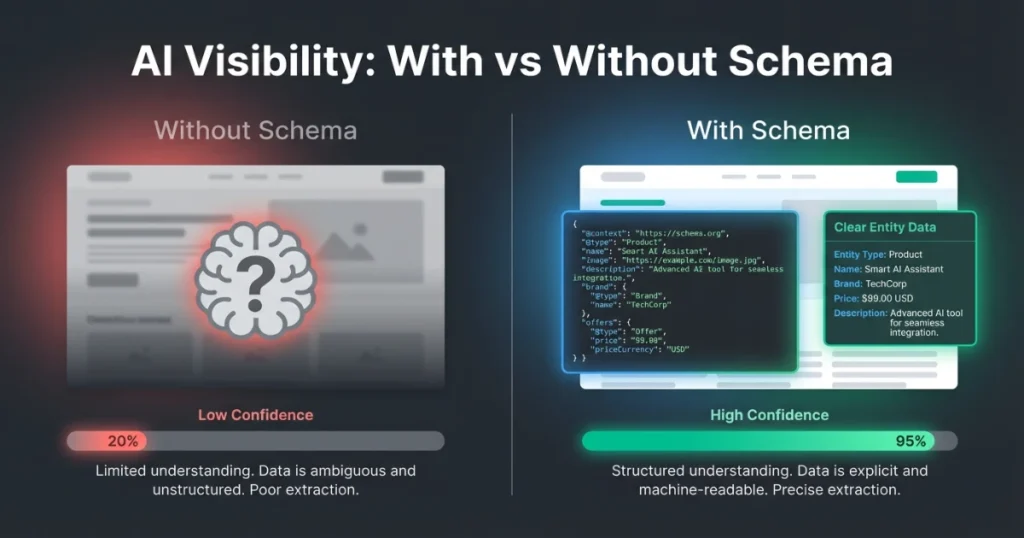
Natural language is ambiguous. Structured data is not.
JSON-LD compresses meaning into machine-readable vocabulary. It removes interpretation friction.
Structured data is not an SEO trick. It is a machine communication protocol.
When AI systems decide whether to extract and cite your content, semantic clarity becomes a competitive advantage.
Reducing Ambiguity for Machine Learning Models
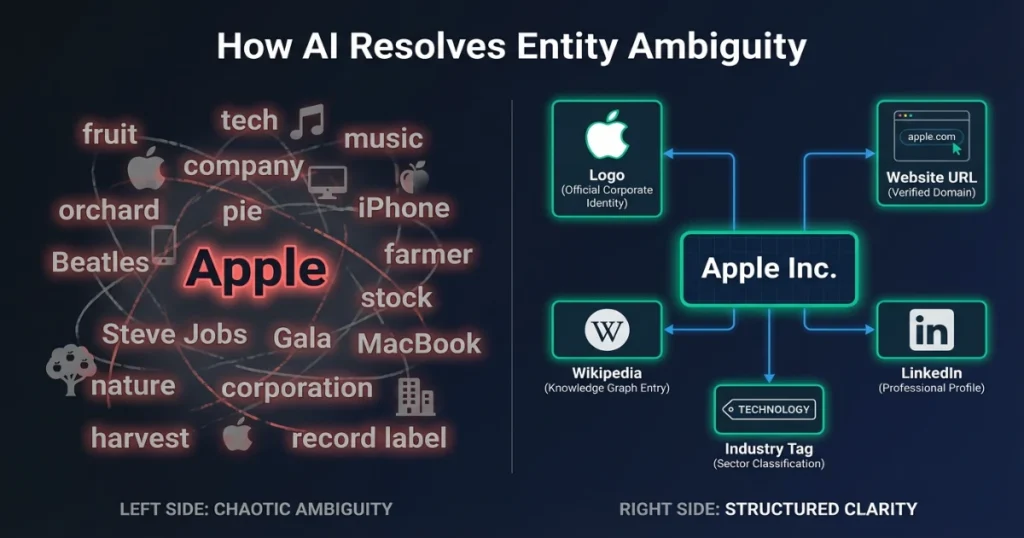
Every NLP model — from BERT to GPT to Google’s Gemini indexing layer — solves the same problem: disambiguation.
When the word “Apple” appears, the model must determine:
- Apple Inc.
- The fruit
- A record label
- A local business
Without structured data, the system infers context.
With Organization schema and sameAs alignment, ambiguity disappears.
Key AI Concepts That Schema Directly Influences
Entity Disambiguation
The process of resolving a textual reference to a unique entity in a knowledge base.
Named Entity Recognition (NER)
The identification of people, brands, locations, and products in unstructured text.
Knowledge Graph Alignment
The linking of your site’s declared entity to Google’s canonical entity records.
Context Compression
How LLMs reduce large content into dense representations. Schema ensures entity signals survive compression.
Google’s Knowledge Graph contains hundreds of billions of entity facts. When your Organization schema includes sameAs links to authoritative profiles, you are aligning your domain with canonical entity records.
That alignment directly influences AI citation confidence.
If you want AI visibility in 2026, you must reduce ambiguity to zero.
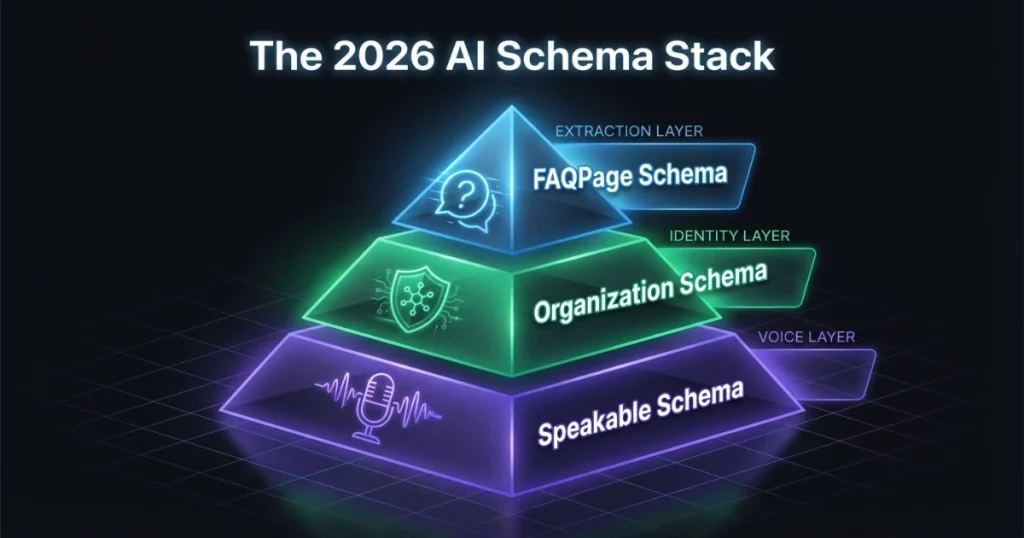
The “Big Three” Schemas for AEO
Answer Engine Optimization is not about ranking position.
It is about extraction eligibility.
The three schema types below produce the highest measurable AI visibility impact.
1. FAQPage Schema — The Holy Grail of AEO
FAQPage schema formats your content into machine-readable Q&A pairs that AI systems can extract instantly.
AI engines are question-answering systems. When you structure content as explicit Q&A in JSON-LD, you eliminate extraction friction.
That’s why FAQPage remains the highest ROI schema for AEO.
Why It Works in AI Overviews
AI Overviews favor:
- Clear question intent
- Self-contained answers
- Direct, extractable structure
- Content-schema consistency
FAQPage provides all four.
Best Practices for AI-Ready FAQs
- 3–10 Q&A pairs per page
- Each answer 40–100 words
- Self-contained responses
- No marketing fluff
- Visible content must match schema exactly
Production-Ready FAQPage JSON-LD
<script type="application/ld+json">
{
  "@context": "https://schema.org",
  "@type": "FAQPage",
  "mainEntity": [
    {
      "@type": "Question",
      "name": "What is schema markup for AI?",
      "acceptedAnswer": {
        "@type": "Answer",
        "text": "Schema markup for AI is structured data using JSON-LD that helps answer engines, AI Overviews, and search systems extract and understand content with precision."
      }
    },
    {
      "@type": "Question",
      "name": "Does FAQPage schema improve AI extraction?",
      "acceptedAnswer": {
        "@type": "Answer",
        "text": "Yes. FAQPage schema pre-formats content as machine-readable question-and-answer pairs, making it easier for AI systems to extract and cite authoritative answers."
      }
    }
  ]
}
</script>
The pages appearing in AI Overviews are not always the highest-authority domains.
They are the most structurally legible ones.
2. Organization Schema — Your Identity Graph
Organization schema establishes your entity identity in machine-readable form and connects it to the broader Knowledge Graph.
In 2026, E-E-A-T is entity verification.
AI systems increasingly ask:
- Is this brand real?
- Is it consistent across platforms?
- Does it map to a confirmed entity?
Organization schema answers those questions.
Core Required Properties
- name (exact match across platforms)
- url (canonical)
- logo (crawlable)
- description (entity clarity, not marketing)
- sameAs (3–10 authoritative profiles)
sameAs: Your Identity Confirmation Network
sameAs is the property that connects your site to your verified presence across the web.
When Google confirms your entity across:
- YouTube
- Twitter/X
- Wikipedia
- Wikidata
It increases entity confidence.
For example, on our own site, we reinforce identity consistency through structured data and entity alignment across profiles and our core service pages such as:
- Local SEO Services
- AEO & AI Search Optimization
- Technical SEO Consulting
These reinforce brand clarity and entity consistency across the digital ecosystem.
Production-Ready Organization Schema
<script type="application/ld+json">
{
  "@context": "https://schema.org",
  "@type": "Organization",
  "name": "Ali SEO Services",
  "url": "https://aliseoservices.com",
  "logo": "https://aliseoservices.com/logo.png",
  "description": "Technical SEO and AI Search Optimization agency specializing in AEO, Local SEO, and structured data strategy.",
  "sameAs": [
    "https://www.linkedin.com/in/liaquat-ali-seo-sp/",
    "https://twitter.com/yourbrand",
    "https://youtube.com/@yourbrand"
  ]
}
</script>
Consistency across these properties strengthens Knowledge Graph association.
3. Speakable Schema — Voice & AI Extraction Layer
Speakable schema identifies which sections of a page are safe for AI and voice systems to read aloud.
As voice interfaces and AI summaries grow, extraction-ready formatting matters.
Where to Apply Speakable
- H1
- Article summary
- Definitions
- Direct answer paragraphs
Production-Ready Speakable Schema
<script type="application/ld+json">
{
  "@context": "https://schema.org",
  "@type": "WebPage",
  "name": "Schema Markup for AI: 3 Tags You Need for 2026",
  "speakable": {
    "@type": "SpeakableSpecification",
    "cssSelector": ["h1", ".article-summary"]
  },
  "url": "https://aliseoservices.com/schema-markup-ai-2026"
}
</script>
While Google historically limited rich results to publishers, AI systems increasingly treat speakable as extraction guidance.
Implementation Errors That Quietly Destroy AI Visibility
1. Content-Schema Mismatch
Every schema value must match visible content.
Hidden FAQ blocks = spam signal.
2. Schema Stuffing
Adding entities not present in the page.
3. Over-Markup
Adding Organization schema to every page unnecessarily.
4. Broken JSON
Trailing commas invalidate the entire script.
5. Inconsistent Brand Naming
If your Organization name differs across platforms, Knowledge Graph alignment weakens.
Validate every deployment using:
- Google Rich Results Test
- Schema Markup Validator
- Search Console Enhancements
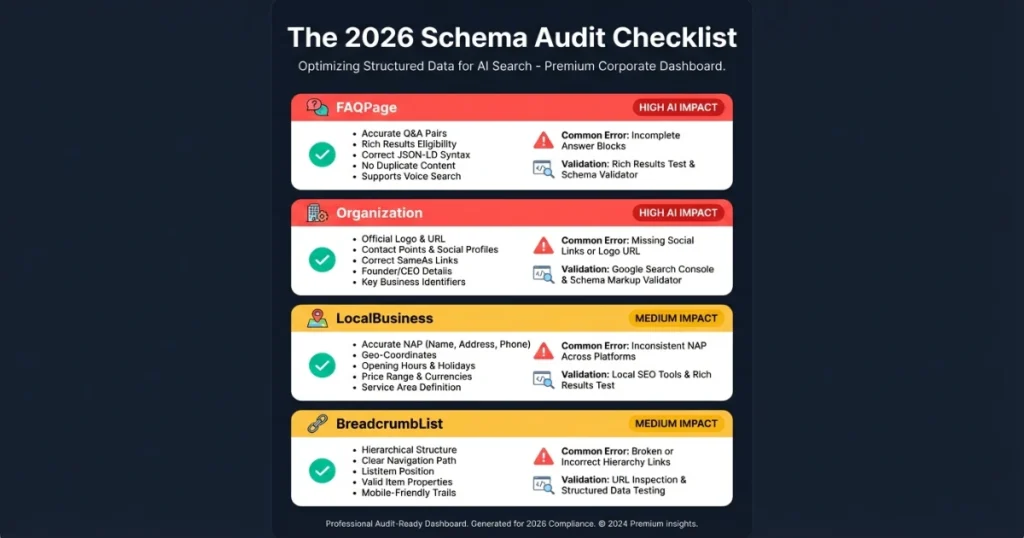
The 2026 Schema Audit Checklist
| Schema Type | Required? | AI Impact | SGE Impact | Common Errors | Validation Tool |
|---|---|---|---|---|---|
| FAQPage | Recommended | 🔴 High | 🔴 High | Hidden FAQ blocks | Rich Results Test |
| Organization | Recommended | 🔴 High | 🔴 High | Missing sameAs | Schema Validator |
| LocalBusiness | If applicable | 🟡 Medium | 🟡 Medium | Address mismatch | GSC |
| BreadcrumbList | Recommended | 🟡 Medium | 🟡 Medium | Position errors | Rich Results Test |
4-Step Schema Deployment Framework (2026)
- Audit entity consistency across platforms
- Deploy Organization schema on homepage
- Add FAQPage to answer-targeted content
- Implement Speakable on summary + definitions
- Validate + monitor monthly
For businesses looking to integrate this properly into a broader AI search strategy, our Technical SEO Consulting service includes full structured data architecture planning and deployment audits.
If your focus is AI extraction visibility specifically, our AEO & AI Search Optimization frameworks integrate FAQ schema, entity reinforcement, and structured extraction targeting into content architecture.
Conclusion: Technical Foundations for AI Visibility
In 2026, content without schema is content asking AI to guess.
And AI does not reward guesswork.
Structured data is the compatibility layer between your expertise and machine intelligence.
FAQPage makes your content extractable.
Organization schema makes your brand verifiable.
Speakable makes your authority readable.
And schema markup is the foundation.
FAQs related Schema Markup for AI: 3 Tags You Need for 2026
1. What is schema markup in AI SEO?
Schema markup in AI SEO is structured data added to a webpage using JSON-LD that helps search engines and AI systems understand entities, relationships, and context. It reduces ambiguity, improves content extraction, and increases the likelihood of appearing in AI Overviews, answer engines, and voice search results.
2. Does schema markup help with AI Overviews?
Yes, schema markup helps with AI Overviews by making content machine-readable and structurally clear. FAQPage, Organization, and Speakable schema improve extraction confidence, allowing AI systems to identify authoritative answers and cite them more accurately in generated summaries.
3. Which schema types are most important for 2026?
The most important schema types for 2026 are FAQPage, Organization, and Speakable. FAQPage structures extractable Q&A content, Organization establishes entity identity in the Knowledge Graph, and Speakable signals voice-ready sections for AI and assistant-based responses.
4. Is FAQPage schema still effective in 2026?
Yes, FAQPage schema remains highly effective in 2026 because AI systems are built around question-answer processing. Structuring content as machine-readable Q&A pairs improves extraction eligibility and increases the chances of being surfaced in AI-generated summaries and voice results.
5. What is the difference between SEO and AEO?
SEO focuses on ranking webpages in search engine results, while Answer Engine Optimization (AEO) focuses on making content extractable and citable by AI systems. AEO prioritizes structured clarity, entity definition, and direct answers rather than traditional ranking signals alone.
6. How does Organization schema improve entity SEO?
Organization schema improves entity SEO by defining a brand’s identity using structured data and linking it to authoritative profiles through the sameAs property. This helps search engines align the website with verified Knowledge Graph entities, strengthening AI trust and citation eligibility.
7. What is the sameAs property in schema markup?
The sameAs property in schema markup links your website’s entity to verified external profiles such as LinkedIn, Wikipedia, or YouTube. It confirms identity consistency across platforms and helps search engines reconcile your brand within the Knowledge Graph.
8. Can incorrect schema markup hurt SEO?
Yes, incorrect schema markup can hurt SEO. If structured data contains hidden content, mismatched information, or syntax errors, it may trigger manual actions or invalidate rich results. Schema must always match visible content and follow official structured data guidelines.
AI Overview Summary
Schema markup is the structured data layer that enables AI systems, answer engines, and search platforms to extract and cite web content accurately. In 2026, three schema types drive the highest AI visibility:
FAQPage for structured Q&A extraction, Organization for entity identity and Knowledge Graph alignment, and Speakable for voice and AI content playback. Correct implementation, visible-content matching, and cross-platform consistency are critical for Answer Engine Optimization success.