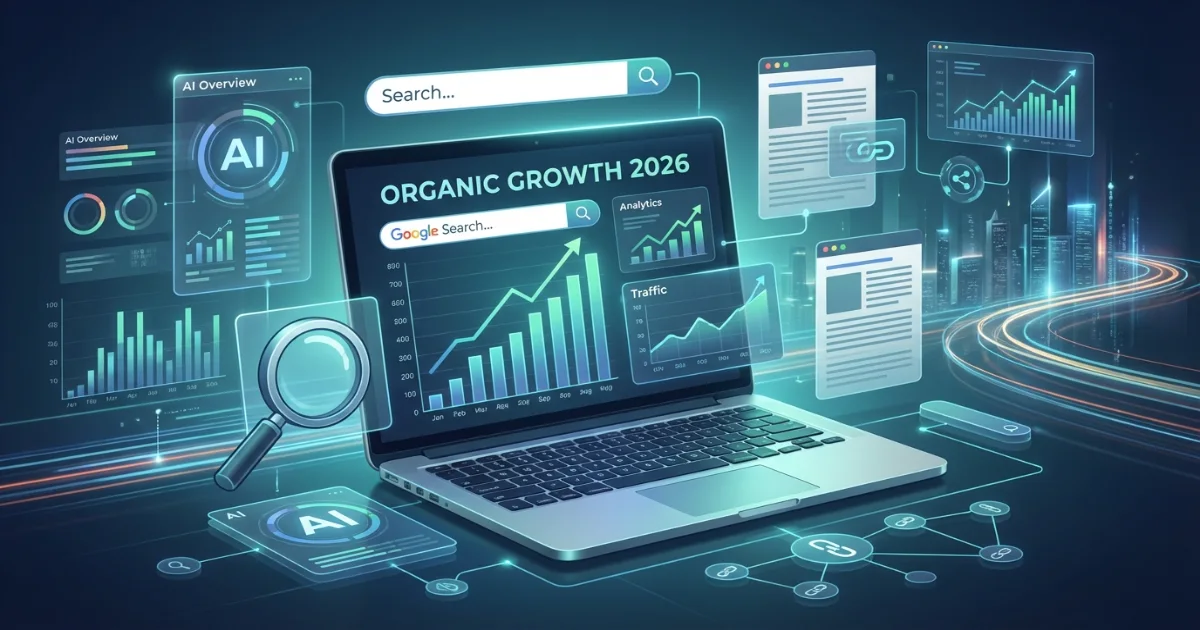
Organic Traffic Generation
Strategies That Actually Work
A no-fluff, data-backed playbook for growing your search traffic in the age of AI Overviews, zero-click searches, and SGE — without spending a dollar on ads.
Organic search remains the #1 traffic driver — but the rules have changed in 2026. Here’s how to win.
Here’s the honest truth: organic traffic is harder to earn than it was three years ago. Google’s AI Overviews now appear in 13% of all queries, reducing CTR by up to 58%. Zero-click searches have crossed the 60% threshold. Yet organic search still drives 53% of all website traffic and delivers a 700% ROI as a long-term channel. The opportunity is real — but your strategy needs to evolve.
📌 Key Takeaways
Search intent alignment is non-negotiable. With 70% of searches being informational, map every page to a specific user need — not just a keyword.
AI visibility runs through traditional SEO. 76.1% of URLs cited in Google AI Overviews already rank in the organic top 10. Win the SERP, win the AI.
Original research earns 2.1× more backlinks. Proprietary data is your most sustainable link-building asset in 2026.
Video multiplies reach by 157%. Search results featuring video content drive dramatically more organic clicks than text-only pages.
Mobile-first isn’t optional. 62.7% of global traffic is mobile. If your site isn’t fast on phones, you’re bleeding traffic daily.
Measure behavior, not just rankings. Scroll depth, return visits, and conversion assists reveal what rankings alone cannot.
Step One: Understand Your Audience (Deeply)
Every organic traffic strategy lives or dies on how well you understand the people searching. Not their demographics — their psychology. What keeps them up at night? What outcome are they desperate for? A searcher typing “best running shoes for flat feet” isn’t shopping for shoes — they’re searching for pain relief. Your content must answer that unspoken need.
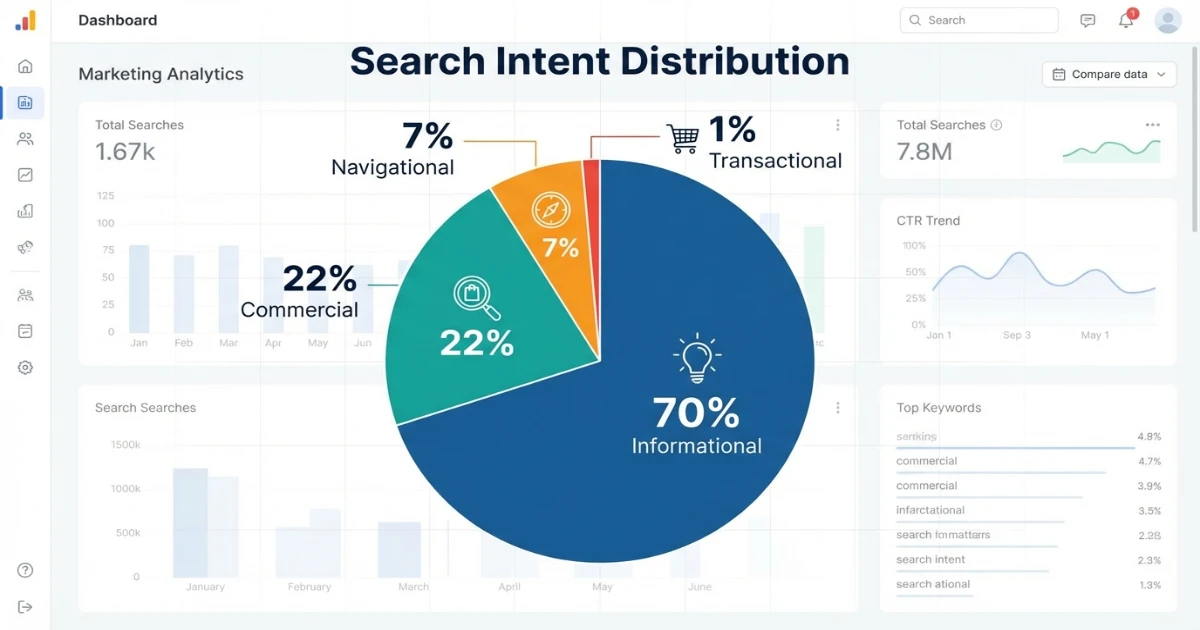
2025 data: 70% of searches are informational — yet most brands only optimize for commercial and transactional queries. (SE Ranking, 2025)
Map Intent to Format
One of the fastest ways to grow organic traffic is simply matching your content format to what the user actually wants. Here’s how to do it by intent type:
| Intent Type | Share of Searches | Ideal Format | Content Goal |
|---|---|---|---|
| Informational | 70% | Guides, how-tos, FAQs, glossaries | Educate & earn trust |
| Commercial | 22% | Comparisons, “best of” lists, reviews | Help decide |
| Navigational | 7% | Branded landing pages, login pages | Fast, direct access |
| Transactional | 1% | Product pages, demos, pricing | Convert immediately |
If an informational page starts attracting commercial-intent visitors (visible in Search Console), add a clear CTA and structured data to capture conversion intent without compromising the page’s core educational purpose.
Behavioral Analytics: Stop Guessing
High bounce rate with a short session? You have a content-intent mismatch or a slow page. High bounce rate with long time-on-page? They got what they needed — add soft CTAs and related internal links to keep them exploring. The professional SEO approach requires reading behavior, not just traffic numbers.
- Track organic sessions, non-brand clicks, and assisted conversions separately
- Use Google Analytics 4 for conversion paths + Google Search Console for query-level data
- Deploy heatmaps (Hotjar or Microsoft Clarity — both free) to see scroll depth and rage clicks
- Set conversion goals for newsletter sign-ups, demo requests, and downloads
- Segment bounce rate by intent type and device — mobile often behaves very differently
Strategy 1 — Build a Research Foundation
Before writing a single word of content, you need a map. Proper keyword research isn’t about finding high-volume terms to rank for — it’s about understanding the actual landscape of demand your potential readers are expressing through search. In 2026, that landscape includes traditional Google results, AI-generated answers, People Also Ask boxes, and featured snippets.
Nearly 74% of all keywords get fewer than 10 monthly searches. Only 0.024% exceed 100,000 searches/month. The real opportunity — and 92% of search volume — lives in long-tail, specific queries where competition is lower and intent is clearer. (SE Ranking, 2025)
How to Build Your Keyword Map
Identify seed topics — 5 to 10 core themes your audience cares about. These are your content clusters. Start broad, then narrow.
Expand with long-tails and questions — Use Google’s “People Also Ask”, Search Console queries, and tools like Ahrefs or Semrush to find real user questions within each cluster.
Assess SERP features — Note which queries trigger AI Overviews, featured snippets, videos, or images. These change your content format and schema strategy.
Score by intent + difficulty — Prioritize queries where you can realistically rank within 60 to 90 days. Low-competition long-tails hit page one fastest — our data shows 60 to 90 days for clusters built early.
Study competitor gaps — Find pages with strong backlinks but shallow content, questions competitors ignore, and formats they don’t use.
Open Google Search Console → Performance → Queries. Filter for keywords ranking positions 5–15 with more than 500 impressions. These are your fastest ranking wins — small on-page improvements can push them to page one within weeks.
Strategy 2 — Create Content Worth Ranking
The bar for “quality content” has never been higher — and the stakes have never been greater. Effective content marketing in 2026 means producing material that is genuinely more useful, more complete, and more trustworthy than whatever currently occupies page one. One deep-dive, well-referenced article consistently outperforms a dozen thin posts.
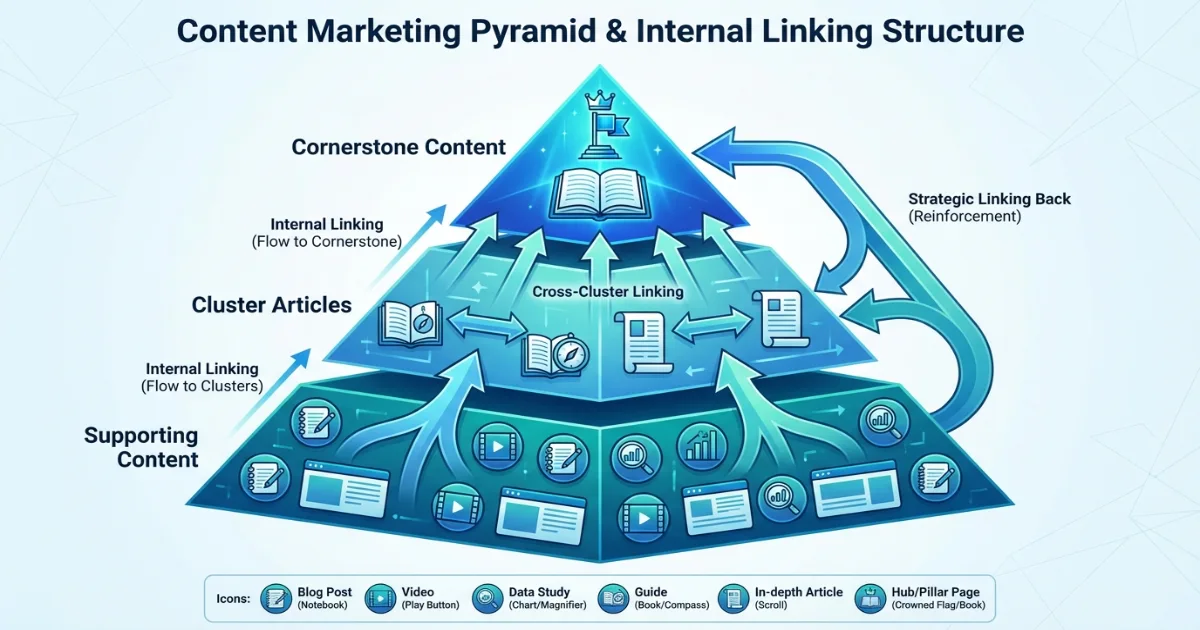
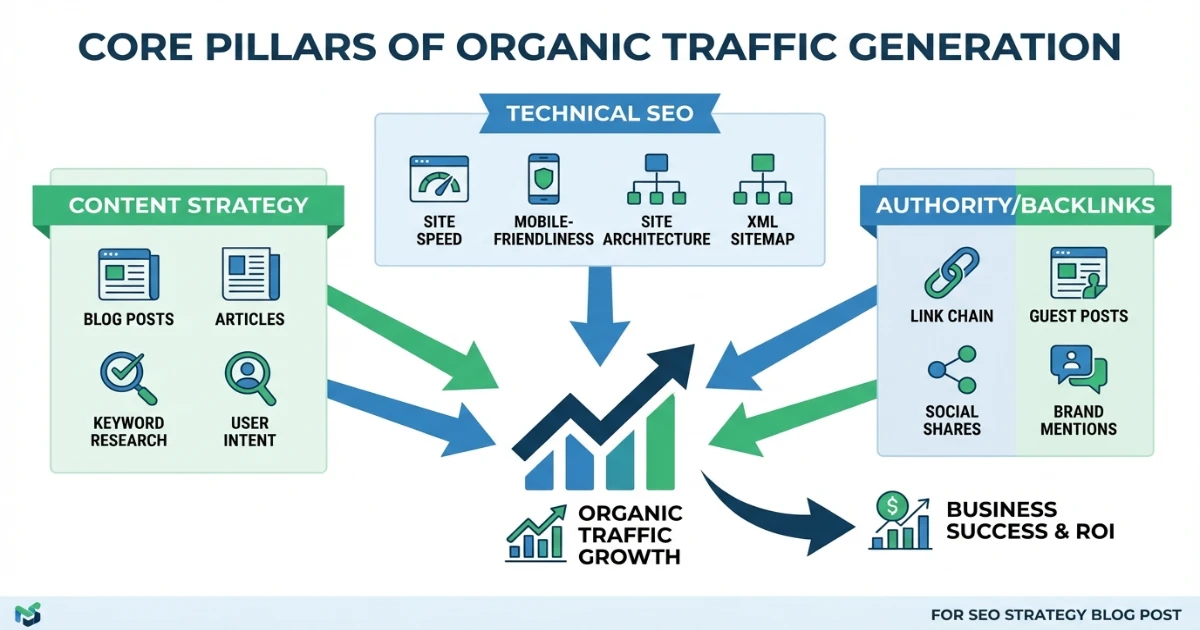
The content hierarchy: one authoritative cornerstone page, supported by cluster articles, all internally linked — this structure is what Google’s E-E-A-T signals reward most.
Content Formats That Drive More Organic Traffic
Search results with videos drive 157% more organic traffic than text-only pages. Video content earns a 41% higher CTR and appears in 26% of Google’s search thumbnails. But the format mix matters by intent:
| Format | Best For | Organic Impact | Difficulty |
|---|---|---|---|
| Long-form guides (2,000+ words) | Informational queries | High | Medium |
| Short explainer videos | How-to & commercial | Very High | Medium |
| Original research / data studies | Authority & links | Very High | High |
| Comparison tables | Commercial investigation | High | Low |
| Case studies with real metrics | Bottom-of-funnel | Medium | Medium |
| Interactive tools (calculators) | Engagement & links | High | High |
Problem-solving posts beat listicles by 28% in CTR. Lead with actionable steps, not fluff. White papers convert at 4.6%, case studies at 3.5%, landing pages at 3.1% — use the right format for the right stage. (FirstPageSage, 2025)
Content Consolidation — The Underused Power Move
If you’ve been publishing for a while, you almost certainly have content cannibalization happening — multiple pages competing for the same keyword. Consolidating similar posts into a single, comprehensive page can dramatically lift both rankings and trust signals. Trim or merge fragile articles. This is one of the most impactful tactics our SEO optimization team uses for clients seeing traffic plateaus.
Strategy 3 — On-Page Optimization That Actually Moves Rankings
On-page SEO is your direct line to the ranking algorithm. It’s where most sites leave easy wins on the table. Here’s what the 2025–2026 data confirms you can’t ignore:
- Title tags of 40–60 characters achieve the highest organic CTR (Backlinko, 2025)
- URLs containing the target keyword earn 45% higher CTR than those without
- 25% of top-ranking pages are missing meta descriptions — yours is an immediate differentiator
- Google rewrites too-long titles 57% of the time — keep them tight and on-intent
- Match H1 to H3 headings to specific user questions, not just keywords
- Use FAQ, HowTo, and Product schema to qualify for rich results and increase SERP footprint
- Optimize images: compress, add descriptive alt text, use descriptive filenames
- Build internal links from high-authority pages to pages you want to rank — this is free PageRank flow
For AI Overview and SGE visibility: use Q&A structured content with clear headings, write direct 25–40 word answer definitions at the top of each section, mark up FAQs with schema, and ensure fast page speeds. Content depth and readability matter more than backlinks for AI citation. (Growth Memo, 2025)
Is Your Site Optimized for 2026’s SEO Landscape?
Get a free technical + on-page SEO audit from the Ali SEO Services team and discover exactly where you’re losing organic traffic.
Strategy 4 — Technical SEO: The Silent Traffic Killer
Only 54.6% of websites meet Core Web Vitals thresholds as of late 2025 (Chrome UX Report). That means nearly half of all sites are actively penalized in rankings due to technical issues — and most of their owners don’t know it. Technical SEO isn’t glamorous, but it’s the floor everything else sits on.
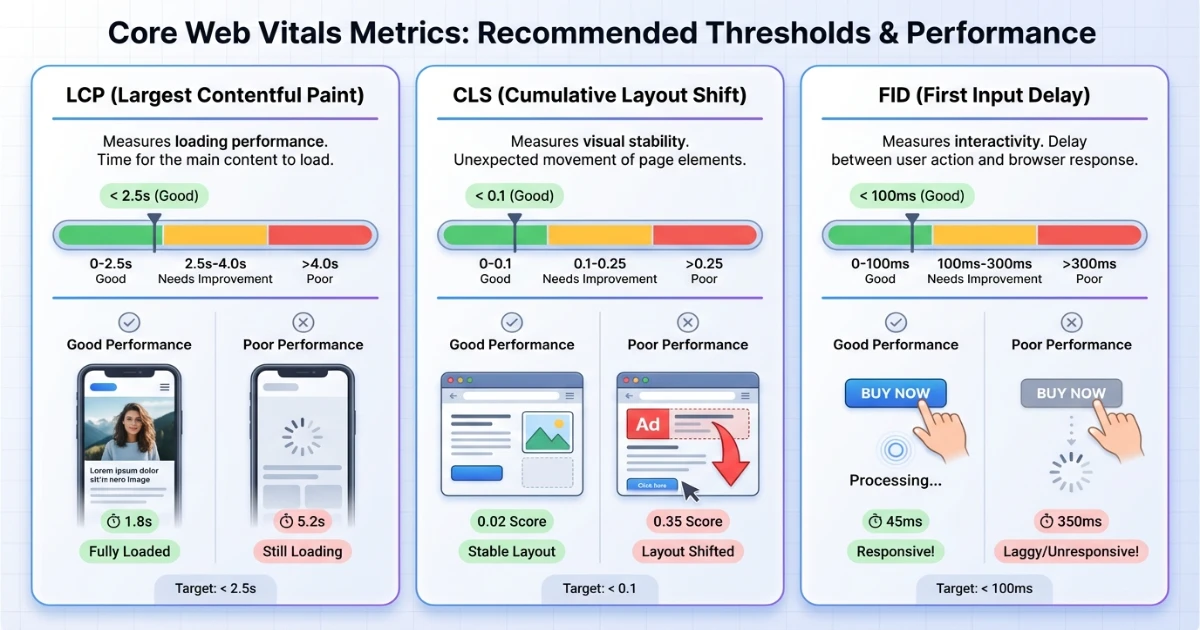
Core Web Vitals are a confirmed ranking signal. Only 54.6% of sites pass all three metrics. Fix them and you have an immediate edge over nearly half your competitors.
Technical SEO Priorities for 2026
Core Web Vitals — Target LCP under 2.5 seconds, CLS under 0.1, FID under 100ms. Use PageSpeed Insights and Chrome UX Report to monitor.
Crawlability — Repair crawl errors, broken internal links, and redirect chains. 23% of sites have XML sitemaps with redirect URLs in them — clean yours up.
Mobile optimization — 62.7% of traffic is mobile. Use Google’s Mobile-Friendly Test and ensure tap targets, font sizes, and layouts work on small screens.
HTTPS & security — Non-HTTPS sites get security warnings in Chrome. This kills trust and CTR instantly.
Duplicate content & canonicalization — Canonical tags prevent ranking dilution across paginated or near-duplicate pages.
Structured data — Schema markup makes your pages eligible for rich results. 85% of SERPs show the Related Searches feature; 79% show Review rich results.
Run a free crawl of your site using Screaming Frog (free up to 500 URLs) and filter for 4xx errors and redirect chains. Fix these first — they are bleeding your link equity and confusing Googlebot.
Strategy 5 — Build Digital Authority with Links & Original Research
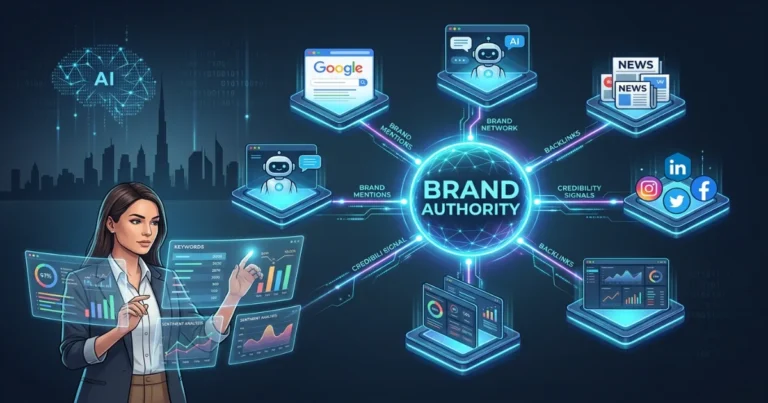
Backlinks remain a primary ranking signal in 2026, and the emphasis on quality over quantity has never been stronger. Strategic link building isn’t about chasing metrics — it’s about earning third-party validation that signals to Google your content is worth trusting.
Websites with original research saw an average 42.2% growth in backlinks, and 96.9% gained more links overall. Original charts earned 2.1× more referring domains than standard posts. (StrataBeat / our internal study)
Link Building Tactics That Work in 2026
- Original data & research: Surveys (300–500 sample minimum), usage data analysis, field trial summaries. Add downloadable data files and charts with clear methodology.
- Broken link building: Find broken links on relevant authority pages, offer your content as a working replacement — highly scalable with tools like Ahrefs.
- Digital PR via HARO/Help a B2B Writer: Provide expert quotes + proprietary statistics to journalists seeking sources. Earn editorial backlinks from major publications.
- Guest posting: Only on topically relevant sites with real audiences. New angles, not recycled tips — pitch editors with a factual 3-line note.
- Link intersect: Find sites linking to 3+ of your competitors but not you — these are your most probable link targets.
- Skyscraper technique: Find high-ranking, high-backlink content in your niche, create a significantly better and more current version, then reach out to linkers.
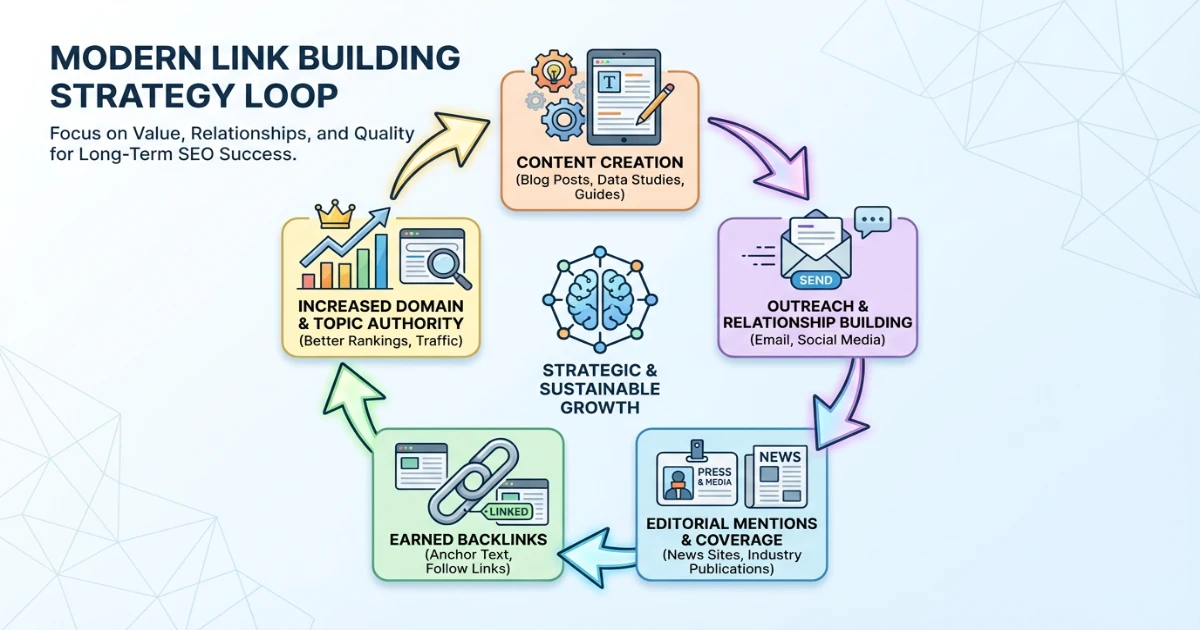
An effective link building strategy flows from content worth linking to → identification of link targets → personalized value-led outreach → relationship maintenance.
Strategies 6–9 — Beyond Traditional SEO: Voice, AI, Video & Interactive
Strategy 6: Voice Search Optimization
Voice assistant users in the US will reach 157 million by 2026. The typical voice search result page has 2,312 words on the source page. To capture voice traffic: target question-based keywords, write direct conversational answers in 25 to 40 words at the top of each section, use FAQ schema, and ensure fast page loads. Voice searches are almost exclusively informational — serve that intent clearly.
Strategy 7: Optimize for AI Overviews (AEO)
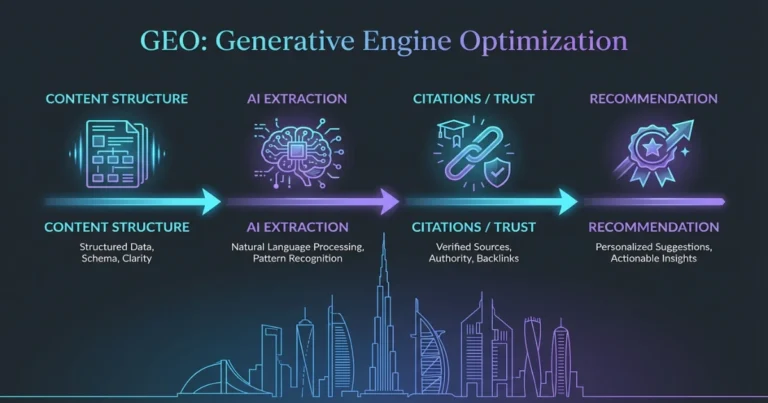
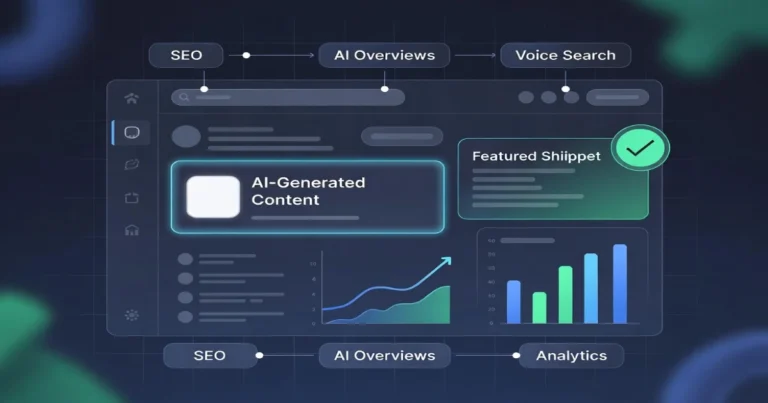
Google’s AI Overviews now appear in roughly 13% of queries and are still expanding. The 47–58% CTR reduction when AIO appears sounds alarming — but 76.1% of URLs cited in AIOs already rank in the traditional top 10. Your best AEO strategy is simply outstanding traditional SEO, combined with:
- Structured Q&A content with clear, direct answers near the top of each section
- Comprehensive FAQ sections with schema markup
- Fast-loading pages (content that loads faster is more frequently cited by AI)
- Recent content — 85% of AI Overview citations are from the last two years; 44% are from 2025
- High E-E-A-T signals: author bios, original data, expert citations, and transparent methodology
Strategy 8: Video SEO
Video content is 50× more likely to appear on Google’s first page than plain text. Embed short, relevant video clips in your cornerstone content. Transcribe and chapter the content. Publish highlights as long-tail standalone pages with internal links back to the full asset. YouTube is the second most-visited website in the US by organic traffic — a YouTube presence feeds your site traffic indirectly through brand searches.
Strategy 9: Interactive Content & Tools
Websites offering free tools — ROI calculators, TCO comparisons, cost estimators — see 35.6% year-over-year growth in monthly organic traffic. Interactive elements increase dwell time, earn natural backlinks, and create social sharing moments. Track completion rate, time-on-tool, assisted conversions, and referral links earned. If a tool loads slowly, lazy-load scripts and minify resources — speed matters for both UX and AI citation.
LLM visitors convert 4.4× better than organic search visitors (Semrush, July 2025), and AI-referred sessions grew 527% year-over-year. But total AI referral traffic still accounts for only 1.08% of all website traffic — organic search remains 70× larger. Build for both, but don’t abandon what’s working.
Strategies 10–11 — Amplify and Repurpose Your Content
Strategy 10: Multi-Channel Promotion
Great content without promotion is a tree falling in an empty forest. But amplification isn’t about blasting everything everywhere — it’s about placing the right content in front of the right audience on the channel where they actually spend time. According to 2025 data, 50% of Google searches feature at least one social media platform in the top 10 — Reddit (37%), YouTube (19.8%), and Quora (8%) lead the pack.
- Share fresh and updated content on the channels your audience uses — customize format per platform
- LinkedIn: short text post with a powerful statistic, link in comments
- Reddit & Quora: contribute genuinely first, share links only where contextually appropriate
- Email: digest format aggregating related posts with short summaries and links to the main asset
- Use UTM parameters on every shared link to accurately attribute traffic in GA4
- Pin top-performing content on social profiles; boost posts with 3–5 organic impressions per week before deciding whether to promote
Strategy 11: Content Repurposing
Break a long guide into a video walkthrough, a podcast episode, a slide deck, a newsletter thread, and a one-page template. Each new format creates a new entry point to your content and reinforces topical authority signals. This is the most cost-effective way to multiply the reach of content you’ve already invested heavily in creating. Our content marketing service specializes in building repurposing workflows that make every piece of content work 5× harder.

The repurposing multiplier: one deep article becomes 6+ pieces of content across channels — each driving traffic back to the source asset.
Strategy 12 — Measure, Test, and Compound Your Growth
Organic traffic growth is not linear — it compounds. But only if you’re systematically learning from what the data tells you and acting on it. This final strategy ties everything together into a continuous improvement loop that separates sites that plateau from sites that keep growing.
Your Core KPI Dashboard
| Metric | Tool | Review Frequency | Action Trigger |
|---|---|---|---|
| Organic sessions | GA4 | Weekly | Drop >15% week-over-week |
| Non-brand clicks + impressions | Search Console | Weekly | CTR <3% with high impressions |
| Average ranking by topic cluster | Rank tracker | Weekly | Drop >3 positions |
| Conversion rate (organic) | GA4 | Monthly | Below industry benchmark |
| Core Web Vitals (LCP, CLS) | PageSpeed Insights | Monthly | LCP >2.5s or CLS >0.1 |
| Backlinks earned | Ahrefs/Semrush | Monthly | Flat for 60+ days |
| Pages with impressions but low CTR | Search Console | Monthly | Position 1–5 with CTR <5% |
A/B Testing That Moves the Needle
The single highest-ROI test you can run: title tags and meta descriptions on pages with high impressions but low CTR in Google Search Console. Test one change at a time, for one full traffic cycle (14–21 days minimum), and measure CTR, scroll depth, and form starts. For example — “Buyer’s guide to noise-canceling headphones” versus “Noise-canceling headphones: buyer’s guide and top picks for 2026” — and let the data decide.
Iteration Cycle
- Expand winning topic clusters — build supporting content around what’s already ranking
- Rewrite titles and meta descriptions on all low-CTR pages quarterly
- Run quarterly technical audits to catch crawl errors and outdated redirects early
- Retire thin pages with zero clicks or backlinks after 6+ months
- Refresh priority pages every 60–120 days with updated statistics and new FAQs
- Document every change with date, hypothesis, and result — this institutional knowledge compounds
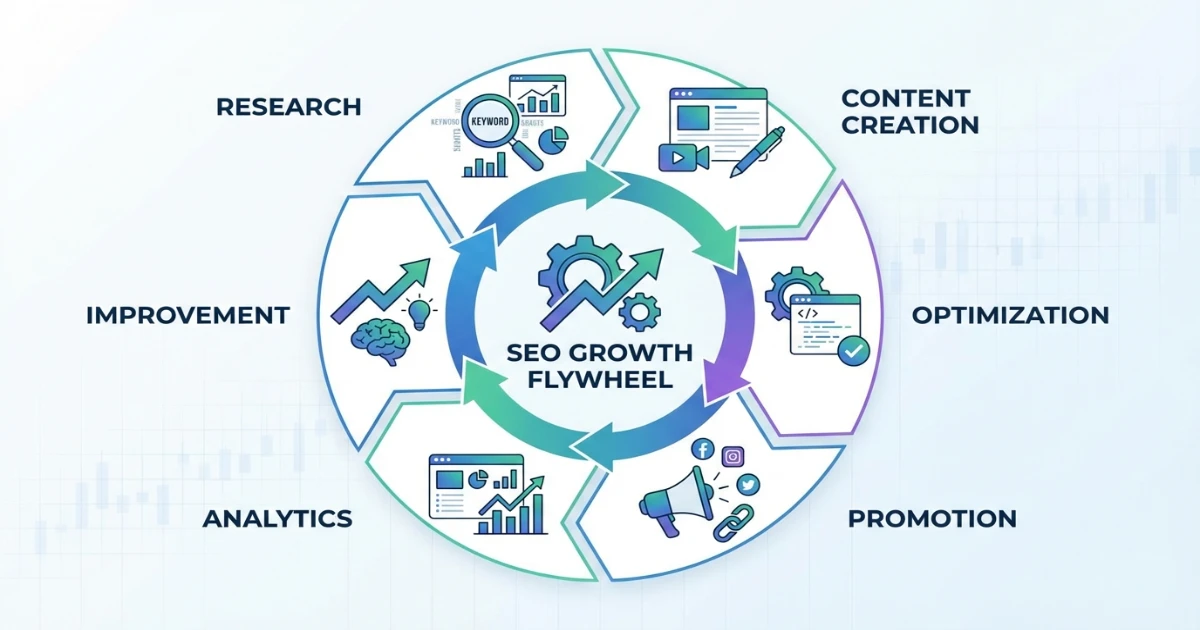
The SEO flywheel: each revolution builds on the last. Content earns links, links improve rankings, rankings attract more searchers, searchers generate data, data improves content.
Month 1: Audit + keyword map + fix top technical issues. Month 2: Publish 2 cornerstone content pieces + update 5 existing pages. Month 3: 2 link-building outreach campaigns + A/B test titles on 10 high-impression pages. Repeat. Small victories compound into significant traffic growth over 6–12 months.
Frequently Asked Questions on Organic Traffic Generation Strategies
Ready to Build Organic Traffic That Compounds?
The Ali SEO Services team works with businesses to implement these exact strategies — from foundational research through technical SEO, content creation, link building, and ongoing measurement. Let’s build your organic growth engine.