Content Strategy · AI + Human
Human + AI: Build a Hybrid Content Creation System for 2026
AI writes fast. Humans write true. The brands winning search in 2026 do both — using AI for speed and scale while humans supply the experience, judgment and voice that algorithms increasingly reward. Here’s the complete system.
- AI drafting
- Human voice
- E-E-A-T signals
- AEO ready
- GEO ready

The model
What hybrid AI + human content creation means
Not “AI writes, human proofreads.” A real hybrid system divides the work by strength — and the division matters more than the tools.
AI’s job: leverage. Research synthesis, first drafts, outline generation, variant creation, metadata, repurposing one asset into many formats. Anything where speed and breadth beat judgment.
Human’s job: truth. Strategy, angle selection, first-hand experience, examples from real work, fact-checking, voice editing, final accountability. Anything where being wrong has a cost.
The handoff between them is the system: briefs constrain the AI, drafts feed the human, and quality gates decide what ships. Most “AI content” failures aren’t AI failures — they’re missing-handoff failures.
- AI accelerates production, never owns accuracy
- Humans add what AI can’t: lived experience
- Every piece passes human review before publish
- Voice guidelines keep output on-brand
- Fact-checking is a stage, not an afterthought
- Performance data feeds back into the briefs
The moment
Why hybrid content matters in 2026
Three shifts made hybrid the default for serious content teams — and pure-AI publishing a liability.
The homogenization crisis
When everyone prompts the same models, everything sounds the same. Readers — and increasingly algorithms — discount interchangeable content. Distinct human perspective is now a differentiator, not a luxury.
Experience gets rewarded
Helpful-content style evaluations consistently favor first-hand experience: tested, photographed, measured, lived. AI can’t have experiences — so the human layer is where ranking power now concentrates.
Answer engines quote sources
AI Overviews, ChatGPT and Perplexity cite specific sources with quotable statements. Generic AI prose rarely earns citations; opinionated, experienced, well-structured human-edited content does.
Roles
Use AI as an assistant, not a replacement
The assistant framing keeps quality high and accountability clear. Here’s what to delegate — and what to never delegate.
Delegate: research & drafting
Let AI summarize sources, generate outlines, draft sections and produce variations. A strong first draft in minutes beats a blank page every time — as raw material, not as output.
Delegate: structure & scale
AI excels at turning one core asset into FAQs, summaries, social variants and translations. Repurposing is pure leverage with near-zero quality risk when a human spot-checks.
Never delegate: facts & claims
AI confidently invents statistics, citations and “expert quotes.” Every factual claim, number and reference must be verified by a human against a primary source before publishing.
Never delegate: judgment
Angle, positioning, what to emphasize, what to omit — these are strategy decisions. AI optimizes for plausibility; humans optimize for truth and business outcomes.
The differentiator
How to inject human voice and experience
This is the layer AI cannot generate and evaluators reward most. Make it systematic, not accidental.
Lead with lived experience. Open key sections with what you’ve actually done: “After auditing 40+ sites…”, “When we tested this…”. First-hand framing is the strongest E-E-A-T signal in the piece.
Add the unpromptable details. The client anecdote, the failed experiment, the counterintuitive result — specifics no model could invent because they happened to you. One concrete story beats three generic paragraphs.
Take a position. AI hedges; experts commit. Clear recommendations (“do this, not that”) with reasoning are more useful, more quotable and more cited than balanced-to-a-fault summaries.
- Every pillar piece contains original experience
- Real examples, numbers and screenshots
- Named authors with verifiable expertise
- Opinions stated plainly, with reasoning
- Voice guide: words you use, words you never use
- Update old pieces with new learnings
The system
What a hybrid workflow looks like
Six stages, each with a clear owner and a quality gate. Nothing ships without passing every gate.
Human brief
Define the audience, angle, key points and sources. A precise brief is the highest-leverage hour in the process — it prevents ten hours of rewriting.
AI draft
Generate the full draft from the brief. Expect strong raw material — structure and coverage mostly there, voice and facts needing work.
Human rewrite
Inject experience, stories, positions and voice. This is where the piece becomes yours — typically the longest stage, and the one that determines quality.
Fact-check
Verify every statistic, quote, date and claim against primary sources. Fix or cut anything unverifiable. No exceptions, no “probably fine.”
Optimize
Apply SEO structure (headings, intent match, internal links), AEO formatting (direct answers, quotable lines) and schema. AI can assist; a human approves.
Measure & feed back
Track rankings, engagement and conversions per piece. Feed what worked back into brief templates — the system compounds.
Integration
Tools, metrics & search integration
The stack is simple; the discipline is the product. And hybrid content plugs directly into modern search.
Supporting tools
A strong LLM for drafting, an SEO suite for briefs and gap analysis, a plagiarism/originality checker, and your CMS with structured templates. Four tools cover nearly every need.
Metrics that matter
Rankings and organic entrances per piece, engagement depth, assisted conversions, and citation frequency in AI answers. Measure outcomes, not output volume.
SEO + AEO + GEO
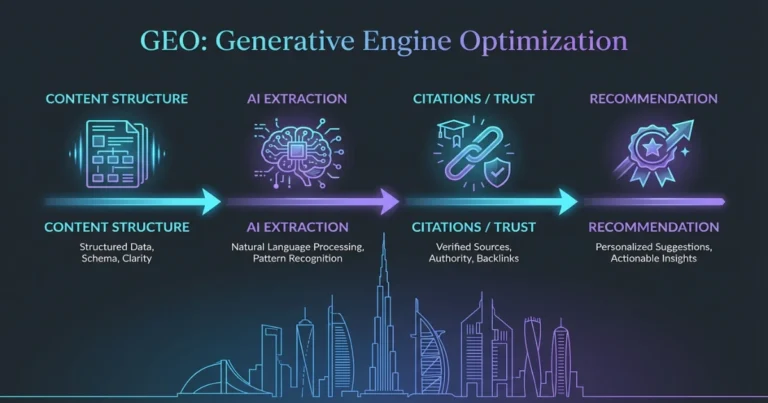
Hybrid content serves all three: depth and structure for classic SEO, direct quotable answers for answer engines, and entity clarity plus first-hand experience for generative citation. One workflow, three surfaces.
On disclosure: be transparent about AI assistance where your audience or regulators expect it, and never present AI-generated claims as tested findings. Trust compounds; shortcuts don’t.
Work with us
Content systems we build for clients
Strategy, briefs, editing and optimization — the human layer of hybrid content, done for you.
Foundation
AED 1,500/month
- Content audit & gap map
- On-page + technical SEO
- Monthly reporting
Growth — most popular
AED 3,500/month
- Everything in Foundation
- Hybrid content briefs & editing
- Topic cluster builds
- AEO/GEO answer formatting
Authority
AED 6,500/month
- Everything in Growth
- Original research & data studies
- Digital PR for citations
- Quarterly strategy with the founder
Key takeaways
- Hybrid = AI for leverage (research, drafting, structure) + humans for truth (strategy, experience, verification).
- The handoff is the system: precise briefs in, quality gates at every stage, nothing ships unreviewed.
- First-hand experience is the differentiator — homogenized AI prose gets discounted by readers and algorithms alike.
- Never delegate facts, claims or strategic judgment to AI; verify everything against primary sources.
- Structure every piece for three surfaces: classic SEO depth, quotable AEO answers, entity-rich GEO signals.
- Measure outcomes per piece and feed winners back into your brief templates — the system compounds.
FAQ
Hybrid content questions, answered
Straight answers, no jargon. Anything else — ask us on the free visibility review.
No — Google penalizes unhelpful content regardless of how it’s produced. Mass-produced AI text with no original value tends to fail helpfulness evaluations, while AI-assisted content with genuine experience and editing performs fine. The method isn’t the issue; the value is.
There’s no fixed ratio, but a useful heuristic: AI produces the raw material — the bulk of first-draft words — and humans reshape it so thoroughly that the published piece is unmistakably theirs. If you could publish the AI draft untouched, your brief was doing the real work — or your standards slipped.
Audience, search intent, angle/position, must-cover points, sources to consult, experience to inject, and what success looks like. The brief is a human strategy document — AI executes it, it doesn’t write it.
Maintain a voice guide with examples: words you use, words you never use, sentence rhythms, how you handle disagreement. Feed it into every brief, and have the same human editor voice-check all output. Consistency comes from the guide, not the model.
Disclose where your audience, industry norms or regulations expect it — and always be honest if asked. More important than a label: never present AI-generated claims as tested findings, and keep a human accountable for everything published.
Answer engines cite sources with clear, quotable, well-structured statements backed by experience. Hybrid workflows naturally produce this: direct answers up front, original examples, entity-rich language and clean formatting — exactly what citation systems select for.
Rankings and organic entrances per piece, engagement depth (time, scroll), assisted conversions, and citation frequency in AI answers. Track per piece against pre-hybrid baselines — output volume alone proves nothing.
Build a content system that scales and ranks
Get a free 15-minute visibility review — we’ll audit your current content, show you where hybrid workflows would move the needle, and map your fastest path to answer-engine visibility.
Claim My Free Visibility Review No pitch decks. No obligation. Just a clear picture of where you stand.Last updated: 2026 · Reviewed by Liaquat Ali, SEO Specialist
Enjoying our SEO & AI search insights?
Make AliSEOservices.com a Preferred Source on Google to see our SEO, AEO, local search and AI visibility insights more prominently in your Google experience.