
How Google Defines Content Quality for AI Overviews
Google AI Overviews define high-quality content by how clearly it answers a user’s question, how easy it is to understand, and how trustworthy the source appears. In 2026, AI systems prioritize pages that explain topics directly, provide meaningful context, and demonstrate real expertise across related content—not pages optimized only for keywords or rankings.
As AI Overviews appear more frequently for informational and complex queries, many websites notice their content missing from AI-generated summaries despite following traditional SEO best practices. This is because AI Overviews are not ranking engines; they are answer-generation systems designed to synthesize reliable information from sources they can understand and trust.
This guide explains how Google AI Overviews evaluate content quality, which principles influence inclusion, and how people-first, E-E-A-T-aligned content remains central to visibility as search continues to evolve.
Key Takeaways
- Google AI Overviews favor content that answers questions clearly and directly.
- Readability, structure, and context matter more than keyword optimization alone.
- Topical authority across multiple related pages increases AI trust.
- E-E-A-T signals remain central to how AI evaluates content quality.
- Clear structure and original insights improve eligibility for AI summaries.
Why Optimizing for AI Overviews Matters in 2026
AI Overviews are not replacing traditional search; they are extending it.
They most often appear for informational, complex, or multi-part queries, typically longer searches such as “how to,” “why does,” or “best practices for.” When your content is cited, visibility can increase significantly — including for pages that may not rank in the top organic positions.
Importantly, traffic from AI Overviews is often higher quality. Users who click through usually do so after gaining context, which filters for more engaged visitors. Research and platform data also indicate that AI-driven search experiences encourage broader exploration and surface more diverse sources.
Focusing on quality today helps future-proof your site across traditional rankings, AI summaries, and evolving search formats.
Core Principles: What “High-Quality” Means for Google AI Overviews
Google’s systems evaluate content based on how well it supports understanding, intent matching, accurate summarization, and cross-referencing. This evaluation is rooted in people-first content and E-E-A-T principles.
Clarity and Readability Beat Complexity
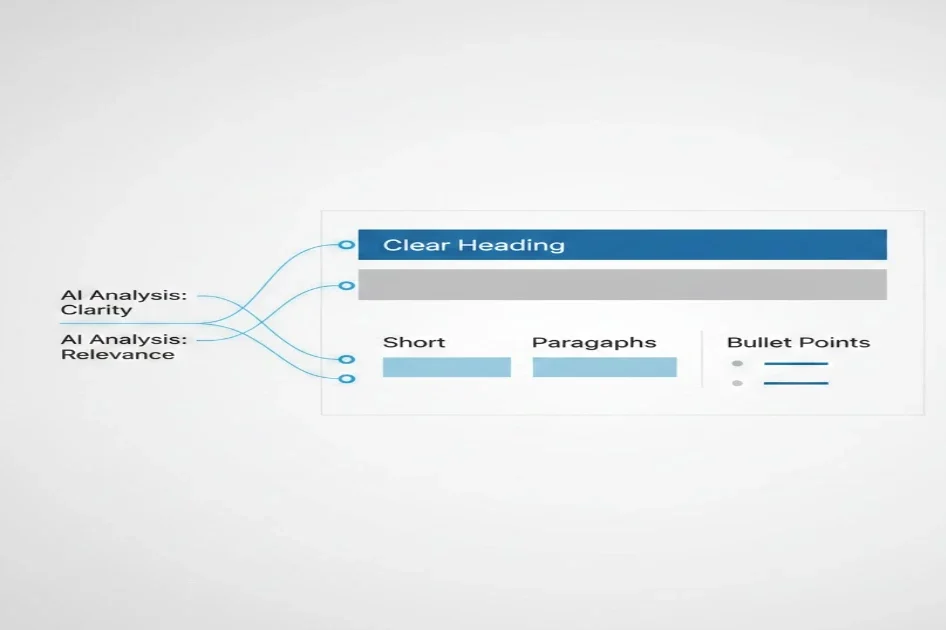
AI systems prioritize content that is easy to understand quickly.
- Use plain language and short paragraphs (ideally three to five sentences)
- Explain terms when jargon is unavoidable
- Avoid unnecessary filler or promotional language
Practical test:
If a reader — or an AI system — can understand your main point within 20–30 seconds, your content is aligned with AI evaluation.
Structured elements such as bullet points, numbered lists, and tables further help AI systems parse and summarize information accurately.
Direct, Immediate Answers Matter More Than Long Introductions
AI Overviews tend to surface content that answers the core question early.
- Open with a concise summary or short TL;DR (around 50–70 words)
- Use clear cause-and-effect explanations
- Respect user time
A useful benchmark is asking whether the main insight makes sense even if someone doesn’t scroll further down the page.
Explanatory Depth (“Why” and “How”) Outperforms Shallow Lists
Content that explains why something works or why a problem exists performs more consistently than content that only lists tips or features.
High-quality pages:
- Provide context and reasoning
- Explain trade-offs
- Connect concepts to real-world use
This depth signals understanding, not just optimization.
Topical Authority Across the Site Matters
AI systems evaluate understanding at the topic level, not just per page.
A site with one article on AI Overviews is typically less compelling than a site with related coverage explaining:
- How AI Overviews work
- How content quality is evaluated
- How performance can be measured
This interconnected coverage signals depth and consistency — something Google has valued long before AI summaries existed.
E-E-A-T and Trust Signals Remain Essential
Trust still plays a critical role.
AI Overviews frequently draw from sources that demonstrate:
- First-hand experience
- Clear expertise
- Consistent identity
- Transparent authorship
This is why you often see a mix of established publishers, niche experts, and community platforms. Smaller sites can appear as well when credibility and accuracy are clear.
Logical Structure Helps AI Interpret Meaning
Google does not state that formatting or schema is required for AI Overviews. In practice, however, structure helps systems understand what matters most.
Effective structure includes:
- Descriptive H2 and H3 headings that reflect real questions
- FAQ sections
- Step-by-step explanations
- Consistent formatting
This is not “AI manipulation.” It’s good communication.
Original Insights Add Real Value
AI Overviews synthesize information from multiple sources. Content that merely repeats existing explanations offers limited value.
Pages that include:
- Practical interpretation
- Experience-based context
- Clear framing
are easier to summarize and more useful to users.
What Google AI Overviews Do Not Prioritize (Common Myths)
Google AI Overviews do not favor:
- Keyword stuffing or AI-specific phrases
- Excessive word count for its own sake
- Overuse of schema as a shortcut
- Aggressive SEO tactics that reduce readability
- Low-effort AI-generated content without human oversight
Quality is evaluated based on usefulness, regardless of how the content was created.

Real-World Query Context (Simple Example)
An informational query such as:
“How does Google decide which sites appear in AI Overviews?”
is far more likely to trigger an AI summary than a transactional query like:
“SEO agency in Dubai.”
This explains why many service-based businesses don’t see AI Overviews for their primary revenue keywords — and why that’s expected behavior.
Your 2026 AI Overview Content Checklist
Before publishing, ask:
- Does this page directly answer a real user question?
- Is the core message clear and easy to scan?
- Does it explain why and provide meaningful context?
- Is expertise and authorship visible?
- Is the content structured with headings, lists, FAQs, or visuals?
- Is it original, accurate, and people-first?
- Is the page fast, mobile-friendly, and technically sound?
If most answers are yes, your content is well positioned for both AI Overviews and traditional search.

Final Takeaway: Focus on Understanding, Not Tricks
AI Overviews extend Google’s long-standing mission: delivering the clearest and most helpful information.
In 2026, success comes from creating content that genuinely helps users — content that is clear, deep, trustworthy, and easy to understand quickly.
There are no shortcuts. Just consistently good content.
For further context, review Google’s official guidance on AI features in Search and people-first content practices.
Google AI Overviews FAQs
Quick, conversational answers designed for AI summaries and voice results. For the full guide, see Google AI Overviews.
Q What are Google AI Overviews? ▾
Q Why is my website not showing in Google AI Overviews? ▾
Q Do I need special “AI SEO” to be included? ▾
Q Does ranking #1 guarantee I’ll appear in AI Overviews? ▾
Q What type of searches trigger AI Overviews most often? ▾
Q Can local businesses still benefit if AI Overviews show less often? ▾
Q Do AI Overviews reduce website traffic? ▾
Q How do I make my content easier for AI to summarize? ▾
Q Is schema required for AI Overviews? ▾
Q Why do Reddit and forums show up in AI Overviews? ▾
Q How can I monitor AI Overview impact in Search Console? ▾
Q What does “content quality” mean for AI Overviews? ▾
Q What’s the best long-term strategy for AI search visibility? ▾
Q Where should I go next to learn more? ▾
Want to Understand How Your Site Performs in AI Search?
If you’re unsure how clearly Google understands your content — or whether your pages are positioned for AI Overviews and future search experiences — a focused review can uncover practical improvements.