Brand Authority & Digital PR in the AI Age 2026: The Complete Strategy Guide
AI-powered search has rewritten the rules of visibility. Discover how to build a consistent, citation-worthy brand that ChatGPT, Google AI Overviews, SGE and Perplexity trust — and actively recommend.
Brand authority in 2026 is built by combining consistent entity signals, expert-led content and credible third-party mentions across every platform AI engines scrape — from Google and Reddit to TikTok and YouTube. Digital PR is no longer about backlinks alone; it is about shaping the trusted narrative that AI systems learn from and cite in answer summaries, SGE panels and AI Overviews.
Why Brand Authority Matters More Than Ever in 2026
Search is no longer a straight line from query to click. A user’s discovery journey might start on TikTok, pivot to a YouTube review, ask ChatGPT for a comparison, scan a Google AI Overview and only then type your brand name directly into Google. Every touchpoint is a potential citation — or a missed opportunity.
Large language models ingest content not just from your website but from press releases, social posts, retailer pages, Reddit threads, podcast transcripts and Wikipedia. Your brand’s reputation is no longer shaped solely by what you publish. It is shaped by what everyone says about you, consistently, across every channel.
The AI Search Ecosystem in 2026
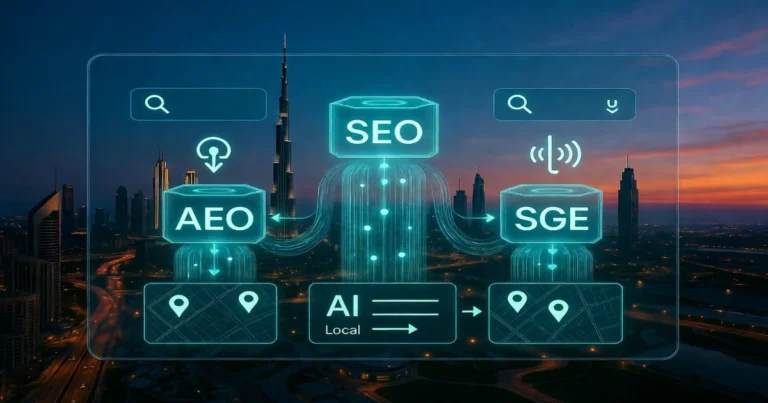
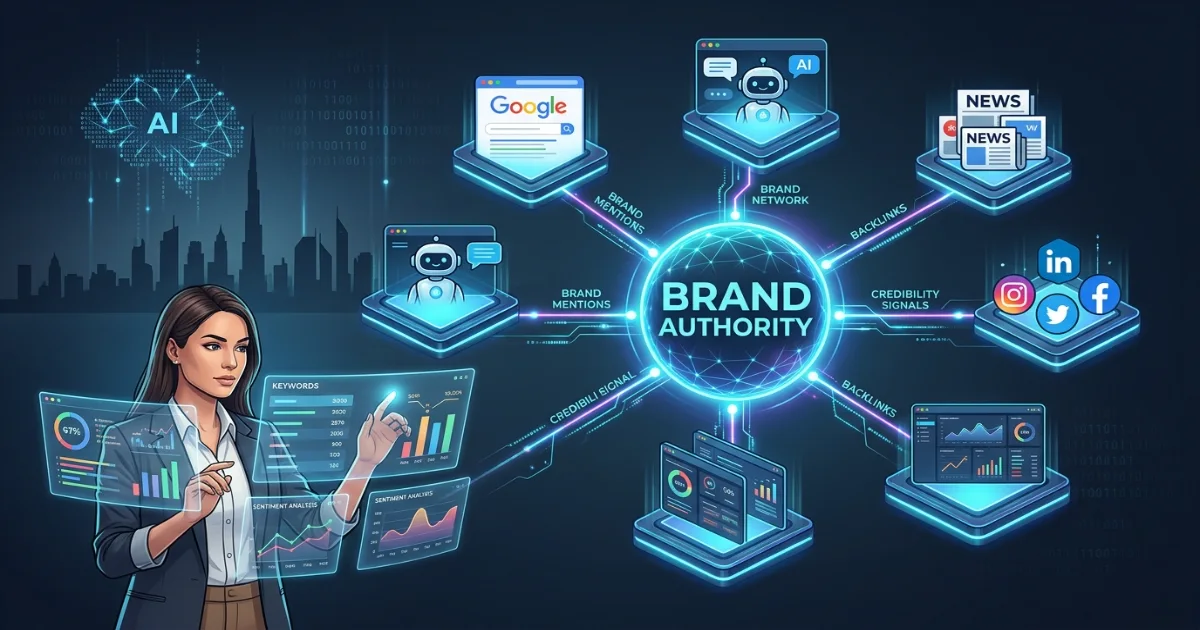
AI engines simultaneously scrape Google, Reddit, YouTube, TikTok, news outlets and social profiles. Brands that maintain consistent, credible signals across all nodes are the ones AI recommends. A fragmented or inconsistent presence tells AI: “these might be different entities” — and that costs you citations.
1 Define a Clear & Consistent Brand Identity for AI Recognition
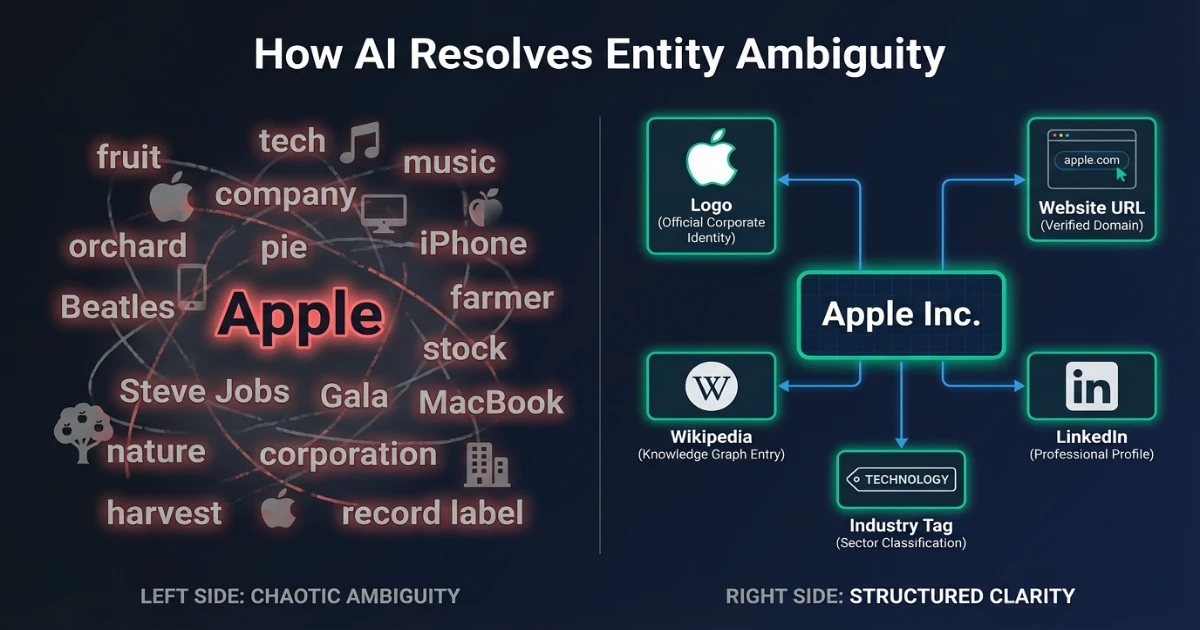
Generative AI models — including ChatGPT, Gemini and Perplexity — rely on entity recognition: they look for repeated references to the same brand across multiple data sources. When your profiles appear inconsistent — different business names on LinkedIn versus Google Business Profile, mismatched taglines or conflicting contact details — AI systems may treat them as separate entities, fragmenting the authority you have worked hard to build.
The Entity Consistency Checklist
- Use your exact business name and tagline identically on LinkedIn, Google Business Profile, YouTube, press mentions and your website.
- Apply
Organizationschema andsameAsmarkup to connect your website, social profiles and knowledge panels programmatically. - Keep NAP data (Name, Address, Phone) byte-for-byte identical across every directory listing and citation source.
- Maintain a unified visual identity — colours, fonts and tone of voice — so both humans and AI recognise you as one entity.
- Use a consistent author byline across all guest posts and press features to build personal authority signals.
2 Align SEO, PR & Social Teams to Build AI-Visible Brand Narratives
The era of the annual press campaign is over. AI engines scrape the web continuously and they reward brands whose messaging is always coherent, always present. Your SEO lead needs to act as a strategic coordinator, ensuring that the same core facts about your brand — your founding story, key credentials, service offerings, case study results and client testimonials — are reflected identically across blog posts, social captions, press releases, podcast show notes and product pages.
The Always-On AI Brand Narrative Framework
- Align themes weekly — brief all teams on the same 2–3 story angles to push across social, video and press simultaneously.
- Repurpose core content — one expert article becomes a LinkedIn post, a YouTube short, a podcast soundbite and a press quote.
- Participate in community forums — engage authentically on Reddit, Quora and niche communities to shape conversations AI learns from.
- Reinforce the same facts on retailer pages, affiliate content and partner sites to create consistent entity validation.
3 Earn Credible Third-Party Mentions That AI Engines Count as Endorsements
Authority cannot be self-declared. AI systems learn credibility the same way people do — by noticing repeated trust signals from respected, independent sources. When a respected industry publication quotes your CEO, when a popular podcast references your research, when a Reddit power user links to your guide — these signals tell AI engines: this brand is considered credible by sources I trust.
The result? Higher citation frequency in AI-generated answers, improved knowledge panel completeness and better representation in Google AI Overviews and SGE results. For service businesses in competitive markets like Dubai and the UAE, this is even more critical — users compare multiple providers quickly and brand trust often decides who gets the lead.
How to Earn AI-Visible Third-Party Citations
- Target niche industry publications and podcasts that align precisely with your expertise — relevance beats reach for entity authority.
- Pitch genuinely valuable stories — original research, proprietary data and contrarian viewpoints earn coverage that generic press releases never will.
- Use HARO and Qwoted to respond quickly to journalist queries and secure expert quotes in high-authority outlets.
- Keep a media log and implement
sameAsschema linking every feature back to your canonical website entity. - Cultivate journalist relationships so you become a go-to expert source, generating repeat citations over time.
4 Create Expert-Led, Experience-Driven Content AI Cannot Replicate
AI can generate generic content faster than any human team. The only content that stands out in 2026 is distinctive, expert-led material built on original research, first-hand data and evidence-backed stances. Google’s E-E-A-T framework — Experience, Expertise, Authoritativeness, Trustworthiness — has merged with AI citation logic: LLMs are trained to surface sources that demonstrate real-world experience, not just keyword-matching content.
The Expert Content Blueprint for AI Visibility
- Publish original research and proprietary data — survey your clients, analyse your results, share unique findings no AI can generate from thin air.
- Use specific metrics — “increased organic traffic by 142% in 4 months” is citable; “improved traffic significantly” is not.
- Include author credentials and bylines with full schema markup — AI engines check author authority as part of content trust evaluation.
- Add real photos, client testimonials and case study evidence — multimodal proof signals lived expertise.
- Take a clear stance — AI citations favour content that provides a definitive answer or perspective, not content that merely describes options.
5 Build a Multi-Platform Presence That AI Engines Trust & Scrape
Customer discovery in 2026 is non-linear. TikTok became one of the most heavily scraped sites for AI training data in 2025. Google AI Overviews increasingly pull from Reddit, YouTube and Wikipedia. A brand absent from these platforms — or present only sporadically — is invisible to the AI systems that influence buyer decisions before a branded Google search even happens.
The goal is not to be everywhere for its own sake. The goal is to be consistently present where your audience researches and where authority signals are formed. For a service-led brand, a smaller number of strong, well-maintained platforms is far better than a scattered, low-quality presence.
The Content Repurposing Matrix for AI Visibility
- Core article → Video → Carousel → Audio: A single expert piece can yield 8–12 platform-native pieces, each reinforcing the same entity signals.
- Link back to your main domain in every platform bio and post description, so AI can resolve all signals to your canonical entity.
- Engage on Reddit and niche communities authentically — Google AI Overviews actively pull Reddit threads as source material.
- Use identical imagery and tagline across profiles and reference each platform with
sameAsstructured data on your website.
6 Measure AI Visibility & Brand Influence — Not Just Traffic
In the zero-click era, click-through rates and keyword rankings are increasingly incomplete indicators. The KPIs that matter in 2026 are brand mention lift, citation frequency in AI answers, share of voice within industry conversations and branded search growth. These are the metrics that tell you whether AI is actually learning to recommend your brand.
Track These Signals Together
- Branded search growth in Search Console and other visibility tools.
- AI Answer inclusion rate — test 10–15 relevant prompts monthly in ChatGPT, Perplexity, Gemini and Google AI Overviews.
- Quality brand mentions across trusted websites (volume and sentiment).
- Impression growth on commercial and informational queries.
- Lead quality and assisted conversions from organic traffic.
- Growth in local visibility through maps, profile interactions and citations.
Entity SEO & Schema Markup: The Technical Foundation of AI Brand Recognition
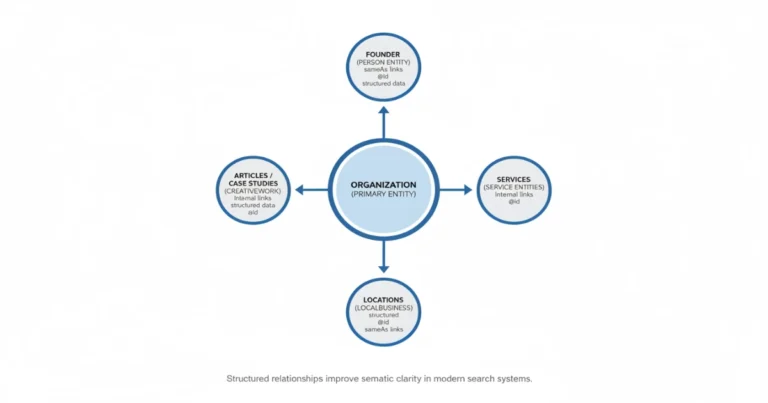
Entity SEO treats your brand as a distinct, verifiable object in the web’s knowledge graph rather than a keyword to match. Google’s Knowledge Graph, Wikidata and the LLMs trained on web data all use entity references to build their understanding of who you are, what you do and whether you can be trusted.
Entity SEO Technical Checklist
- Implement
Organizationschema on your homepage withname,url,logo,description,foundingDate,areaServedandserviceType. - Add
sameAsproperties linking to LinkedIn, Twitter/X, YouTube, Facebook, Crunchbase and Wikipedia pages. - Use
Personschema for key authors and executives to build individual authority signals. - Implement
FAQPageschema on all FAQ content — it feeds directly into People Also Ask boxes and AI Overviews. - Add
BreadcrumbListandWebPageschema to help AI engines understand your site hierarchy. - Create and maintain a Wikidata entity for your brand — LLMs are trained heavily on Wikidata entries.
SGE & AEO Optimisation: How to Win Featured Citations in AI-Generated Answers
SGE (Search Generative Experience) and AEO (Answer Engine Optimisation) represent the new frontier of search visibility. Traditional SEO secured a URL in a ranked list; SGE/AEO secures your brand as a cited source inside the AI-generated answer that millions of users see before they ever scroll to ranked results.
7 SGE & AEO Tactics That Drive AI Citations
- Write direct, question-answering paragraphs — SGE favours content that provides clear, standalone answers to specific long-tail queries.
- Use FAQPage schema on every page — it feeds directly into People Also Ask and AI Overview answer extraction.
- Structure content with H2/H3 question headers matching natural language queries: “How does X work?” “What is the best way to Y?”
- Provide evidence-backed claims — cite your own original data and research. AI engines prioritise sourced claims over bare assertions.
- Target long-tail, conversational queries — these are far more likely to trigger a featured SGE answer than broad head terms.
- Maintain content freshness — update your most important pages quarterly. AI Overview systems check recency signals for factual content.
- Build topical authority clusters — a brand with 20 interlinked expert articles on digital PR is cited more reliably than one with a single page on the topic.
Frequently Asked Questions
Link building is narrower and mainly focuses on backlinks. Digital PR builds broader authority through mentions, coverage, expert commentary, citations and reputation signals across the wider web. In the AI era, that wider layer matters more because answer engines learn from many sources, not just your site.
Digital PR improves AI visibility by increasing trusted mentions, reinforcing your brand narrative and strengthening entity-level trust. The more credible and consistent your brand appears across trusted sources, the easier it becomes for AI systems to surface you as a relevant authority.
Entity SEO helps search engines understand your business as a clear, trusted entity. It uses consistency, schema markup, sameAs references, authorship and web-wide signals to reduce ambiguity and improve trust.
Yes. Focused niche PR, local authority building, expert-led content, testimonials, case studies, founder visibility and strong Google Business Profile optimization can build meaningful authority even with a modest budget.
The most useful indicators are branded search growth, quality brand mentions, impressions, share of voice, assisted leads, local visibility and how often your brand appears in relevant AI-assisted discovery journeys.
Ready to Build a Brand Google and AI Engines Trust?
At Ali SEO Services, we help businesses combine SEO, entity SEO, local search strategy, expert content and digital PR into one authority-building system designed for 2026.
If your goal is better rankings, stronger branded search, higher trust and more qualified leads, this is the work that moves the needle.
Get Your Free Brand Authority Audit Explore Our SEO Services