AI Search Visibility Score Tool(Page-Level)
Advanced page-level analysis for Google SGE, AI Overviews, and Answer Engines. Get actionable insights on AEO optimization, entity relevance, and AI visibility factors that determine search prominence in the AI era.
1. Use the HTML upload feature
2. Check if the URL is publicly accessible
3. Try a different URL
Analyzing page structure, content, and AI readiness…
📊 AI Visibility Score Breakdown
🔍 Page-Level Findings
⚡ Critical Improvements
🎯 AI Readiness Metrics
AI Search Visibility Score Analyzer: How to Measure and Improve Your Website’s AI Rankings in 2026
Search has changed — quietly, but permanently.
In 2026, ranking on Google is no longer just about blue links. Websites now compete for visibility inside AI Overviews, answer engines, voice assistants, and entity-based search results. If your content is not clearly understood and trusted by AI systems, it simply doesn’t get recommended — even if your traditional SEO looks “fine.”
This is exactly why we built the AI Search Visibility Score.
It’s a page-level analyzer designed to answer one critical question:
How visible is this specific page in AI-driven search results — and what needs to be fixed to improve it?
In this guide, we’ll explain:
- What AI Search Visibility actually means
- Why traditional SEO tools are no longer enough
- How AI Overviews evaluate your pages
- What a “good” AI visibility score looks like
- How to use the AI Search Visibility Score tool to improve rankings across Google, SGE, and answer engines
What Is AI Search Visibility?
AI Search Visibility refers to how well artificial intelligence systems can:
- Understand your page
- Trust its information
- Attribute it to a clear entity
- Extract answers from it
- Recommend or cite it in AI-generated responses
These systems include:
- Google AI Overviews (SGE)
- ChatGPT-style answer engines
- Voice assistants
- Entity-based discovery systems
- Local AI-enhanced Maps results
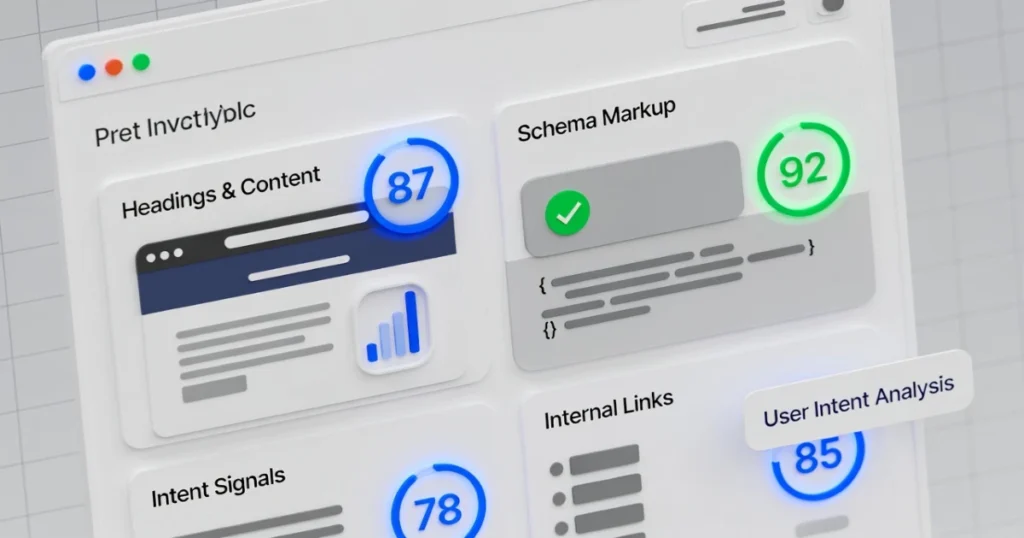
Unlike traditional search, AI doesn’t just look at keywords. It evaluates structure, clarity, entity signals, and semantic intent at the page level.
Why Traditional SEO Scores Are No Longer Enough
Most SEO tools still focus on:
- Backlinks
- Keyword density
- Page speed
- Domain authority
While these factors still matter, they don’t explain why a page is or isn’t cited by AI systems.
Two pages can rank similarly in classic search, but only one appears inside AI Overviews.
Why?
Because AI prioritizes:
- Clear topical focus
- Structured answers
- Entity consistency
- Schema-backed meaning
- Trust and accessibility signals
This gap is exactly what the AI Search Visibility Score is designed to measure.
What the AI Search Visibility Score Measures (Page-Level)
Unlike domain-based tools, this analyzer works on any individual page, including:
- Service pages
- Blog posts
- Landing pages
- Location pages
- Product or solution pages
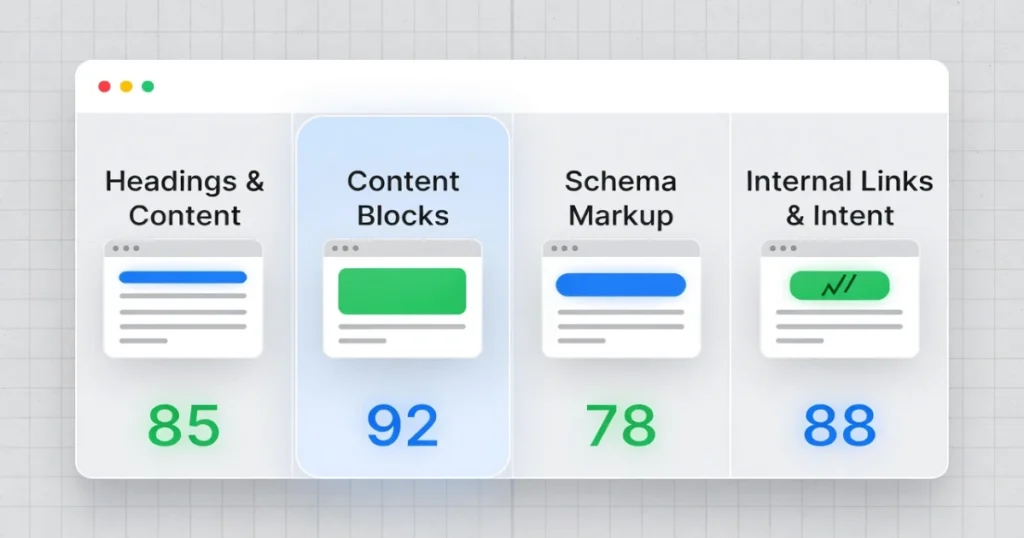
Each page is evaluated across five AI-critical categories:
1. Structural Clarity
AI systems need logical content flow.
This includes:
- Exactly one clear H1
- Proper heading hierarchy (H2 → H3)
- Optimized title length
- Scannable content blocks
If AI struggles to understand structure, it won’t extract answers confidently.
2. Content Depth & AEO Readiness
Answer Engine Optimization (AEO) is no longer optional.
The tool evaluates:
- Content length and depth
- Presence of FAQs or Q&A patterns
- Lists, tables, and explainer sections
- Natural language clarity
Pages that clearly answer questions are far more likely to appear in AI-generated summaries.
3. Technical & Schema Signals
AI systems rely heavily on structured meaning.
The analyzer checks for:
- JSON-LD structured data
- FAQ, Service, Organization, or Entity schema
- Open Graph and social meta data
- Machine-readable trust signals
Schema doesn’t guarantee AI visibility — but without it, your chances drop significantly.
4. Entity & Local Relevance
AI search is entity-first, not keyword-first.
This includes:
- Clear mentions of services, locations, and business context
- Geographic relevance (e.g., Dubai / UAE signals)
- Consistent terminology and intent alignment
Pages with strong entity clarity are easier for AI to trust and recommend.
5. Accessibility & Usability
AI systems increasingly factor accessibility and UX.
Signals include:
- Image alt text coverage
- ARIA labels
- Semantic HTML elements
- Clear internal linking
Accessible pages are easier for both humans and AI to understand.
What Is a “Good” AI Search Visibility Score?
Based on real-world AI behavior and testing:
- 80–100 → Strong AI-ready page
Pages in this range are commonly cited in AI Overviews and answer engines. - 60–79 → Competitive but leaking visibility
Good foundation, but missing clarity or structure. - 40–59 → Average visibility
AI may partially understand the page but lacks trust. - Below 40 → Poor AI visibility
Page is unlikely to be surfaced or cited.
This score is not theoretical — it reflects how AI systems actually parse and evaluate content.
Why Page-Level Analysis Matters More Than Ever
One of the biggest SEO mistakes in 2026 is assuming:
“My domain is strong, so all my pages are fine.”
AI doesn’t think this way.
Each page is evaluated independently:
- A homepage might be AI-ready
- A service page might not
- A blog post could be invisible to AI
That’s why the AI Search Visibility Score analyzes individual URLs, not just domains.
What Makes This Tool Different From Other SEO Tools?
Most tools:
- Break when sites block crawlers
- Rely on generic SEO formulas
- Focus on backlinks over meaning
- Don’t explain AI behavior
This tool:
- Analyzes any page URL
- Uses HTML upload for blocked sites
- Evaluates 50+ AI-era signals
- Produces explainable, actionable results
- Works perfectly inside WordPress (Kadence-safe)
It’s built for real AI search, not outdated SEO checklists.
How to Use the AI Search Visibility Score (Step-by-Step)
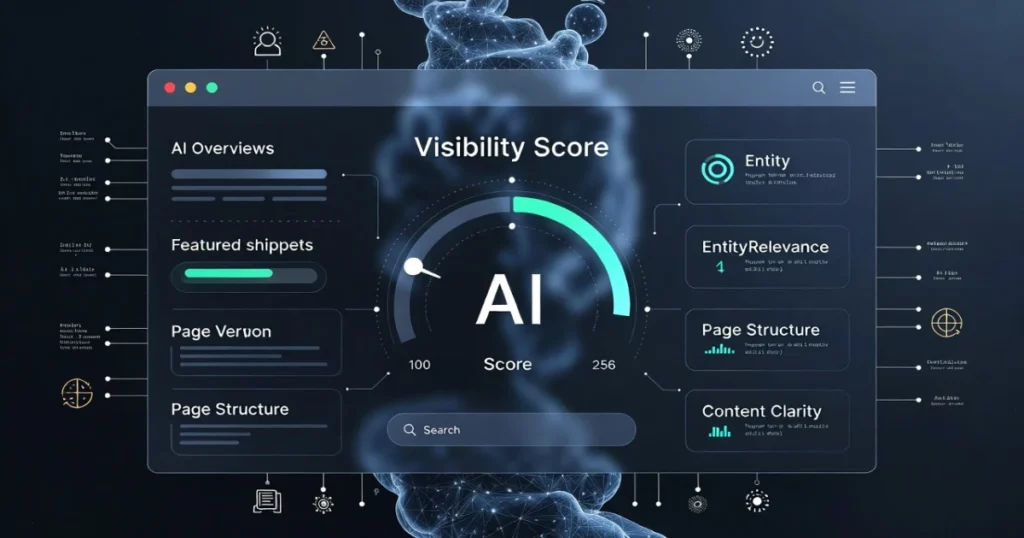
- Enter any page URL
Example: a service page or blog post - If the page blocks scanning
Upload the HTML file instead - Review your overall AI score
Focus first on the category breakdown - Read the page-level findings
These explain exactly what AI sees — and what it misses - Apply the critical improvements
Fixing just the top 3 issues often improves AI visibility within weeks
Who Should Use This Tool?
This tool is ideal for:
- Business owners targeting AI-driven search
- SEO professionals adapting to SGE
- Content teams optimizing blogs for AI answers
- Local businesses competing in Maps + AI results
- Agencies auditing client pages with clarity
If AI search traffic matters to you — this tool gives you a real advantage.
Final Thoughts: SEO Is Now AI Communication
The future of search isn’t about gaming algorithms.
It’s about communicating clearly with AI systems.
Pages that:
- Explain concepts clearly
- Define entities precisely
- Use structured data correctly
- Answer real questions
…are the pages AI chooses to recommend.
The AI Search Visibility Score exists to help you do exactly that.
👉 Use the tool, analyze your pages, and start building AI-first visibility today.
FAQs
What is an AI Search Visibility Score?
An AI Search Visibility Score measures how well a specific web page is understood, trusted, and cited by AI-driven search systems like Google AI Overviews and answer engines.
Is this score for the whole website or one page?
This score is calculated at the page level, not the domain level. Each page is evaluated independently for AI visibility.
What score is considered good for AI rankings?
Pages scoring 80 or above are more likely to be cited in AI Overviews and answer engines, while lower scores indicate visibility gaps.
Does this tool work for blog posts and service pages?
Yes. The tool analyzes any page URL, including blog posts, service pages, landing pages, and location pages.
What if a website blocks scanning?
If a page blocks automated access, you can upload the HTML file to get a full AI visibility analysis.
Does this replace traditional SEO tools?
No. This tool complements traditional SEO tools by focusing on AI-era signals like AEO, entity clarity, and structured understanding.
Is the AI Search Visibility Score accurate?
The score is based on real AI ranking signals such as structure, schema, content clarity, and entity relevance used by modern search systems.
How often should I check my AI Search Visibility Score?
You should recheck your score after major content updates, schema changes, or every 4–8 weeks to track AI visibility improvements.
Ready to Improve Your AI Search Visibility?
Your score reveals how AI systems understand and trust this page. Get a page-specific AEO, Entity, and SGE optimization plan built for real rankings — not guesses.
Get AI SEO Action PlanNo contracts • Page-level focus • AI-era SEO specialist