AI Search KPIs 2026: The New Metrics That Actually Measure Visibility in the Age of Generative Search
What Are AI Search KPIs in 2026?
AI Search KPIs are advanced performance metrics used to measure how often your brand is selected, cited, and trusted inside AI-generated answers across platforms like Google AI Overviews, ChatGPT, and Perplexity. Unlike traditional SEO metrics that track rankings and clicks, AI KPIs focus on brand inclusion, citation frequency, AI share of voice, sentiment, and conversion impact — the signals that determine whether AI recommends you or a competitor.
⚡ Quick Answer
In 2026, traditional SEO metrics like rankings, clicks, and session counts can no longer tell you whether your brand is winning or losing in AI-powered search. Generative engines — Google AI Overviews, ChatGPT, Perplexity — deliver answers without clicks, and up to 60% of queries now end in zero clicks. The new measurement framework uses three tiers: Selection KPIs (are you being chosen?), Credibility KPIs (why are you chosen or skipped?), and Outcome KPIs (what revenue results from AI visibility?). Complement these with five GEO metrics — citation frequency, Brand Visibility Score, AI Share of Voice, sentiment analysis, and LLM conversion rate — and you have a complete performance picture for the generative search era.
AI Search KPIs Explained Simply
- Selection Metrics: Are you appearing in AI answers at all?
- Credibility Metrics: Why AI trusts — or ignores — your brand
- Outcome Metrics: The revenue and conversions driven by AI visibility
Brands that dominate AI search don’t just rank — they are consistently referenced as trusted, authoritative sources across every major generative platform. Learn how AI SEO services can get you there.
Key AI Search KPI Definitions
Brand Inclusion Rate: The percentage of AI-generated answers that explicitly mention or cite your brand for target queries.
AI Share of Voice (AI SOV): Your brand’s share of total citations in your category across AI platforms, compared to competitors.
LLM Conversion Rate: The conversion rate of website visitors arriving from AI platforms such as ChatGPT, Perplexity, or Claude.
Citation Frequency: How often AI systems actively reference your content when generating answers in your niche.
Brand Visibility Score (BVS): A composite score combining citation frequency, placement, link presence, and sentiment across AI engines.
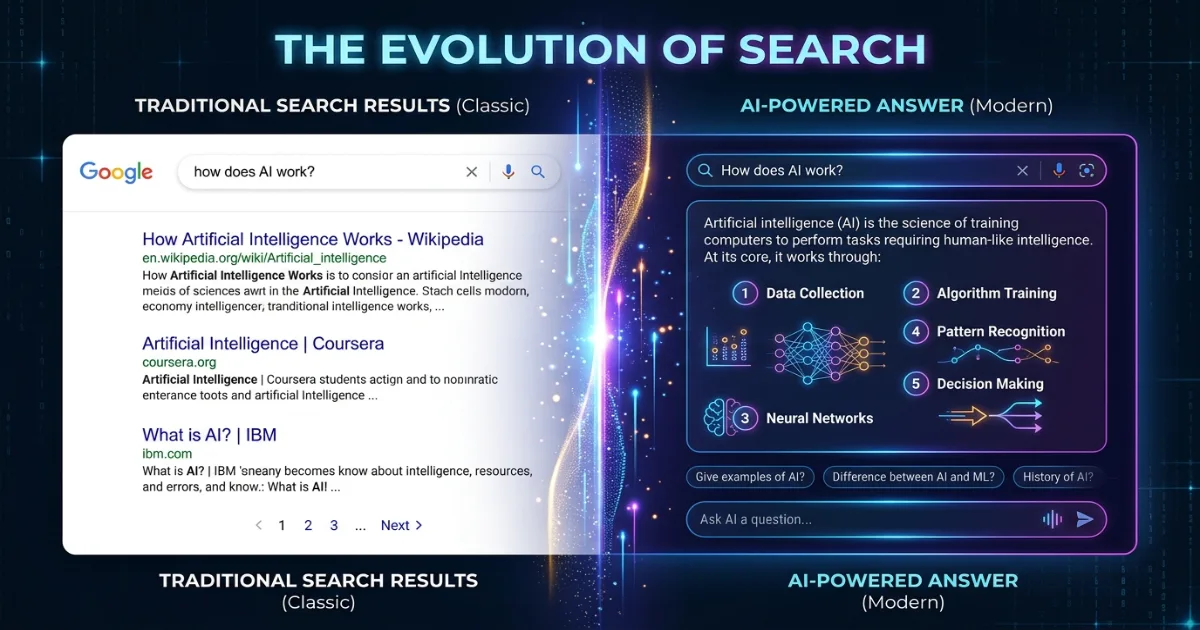
Here’s the uncomfortable truth about your current reporting dashboard: it was designed for a search engine that no longer exists. The version of Google your analytics were built around — blue links, ten organic results, predictable rankings — has been fundamentally restructured. AI has moved in, and it has no interest in sending you clicks.
If your weekly report still leads with keyword positions and organic sessions, you’re measuring the rearview mirror. The decisions that matter — which brand a buyer considers, which product earns a recommendation, which company gets the shortlist — are increasingly being made inside AI-generated answers. And none of that shows up in your rank tracker.
This guide gives you the complete 2026 framework for measuring AI search performance: the right metrics, the right tools, and the strategic logic behind each one. Whether you’re an in-house SEO lead, an agency reporting to clients, or a CMO trying to understand where demand is actually forming, this is the measurement playbook you need right now.
Why Traditional SEO Metrics Are No Longer Enough
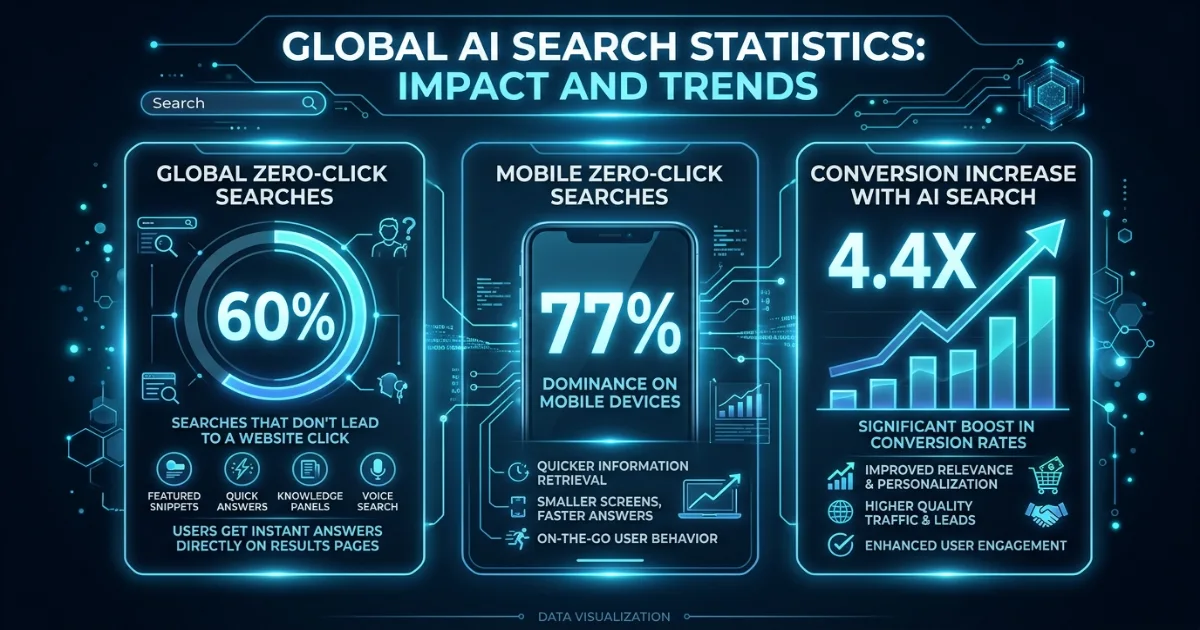
The numbers tell the story plainly. Organic click-through rates for queries that trigger AI Overviews have collapsed from 1.41% to 0.64% — a drop of more than half. On mobile, zero-click rates top 77%. And yet, brands that are cited inside those AI answers convert at 4.4× the rate of traditional organic visitors.
This creates a measurement paradox. Traffic goes down. Revenue goes up. If you’re only tracking sessions, you’ll panic at the wrong number and miss the right opportunity.
The same pattern plays out in B2B. A Forrester study found that 89% of B2B buyers consult generative AI during their purchase journey. The AI recommendation doesn’t drive a click — it shapes a belief. By the time that buyer visits your website, the shortlist is already formed. If you weren’t in the AI answer, you weren’t on the shortlist.
This is where modern SEO strategy must evolve. It’s not enough to rank — you need to be cited, trusted, and recommended by AI systems. And to do that, you first need to measure whether you’re showing up at all.
The AI Search KPI Framework: Three Tiers That Tell the Full Story
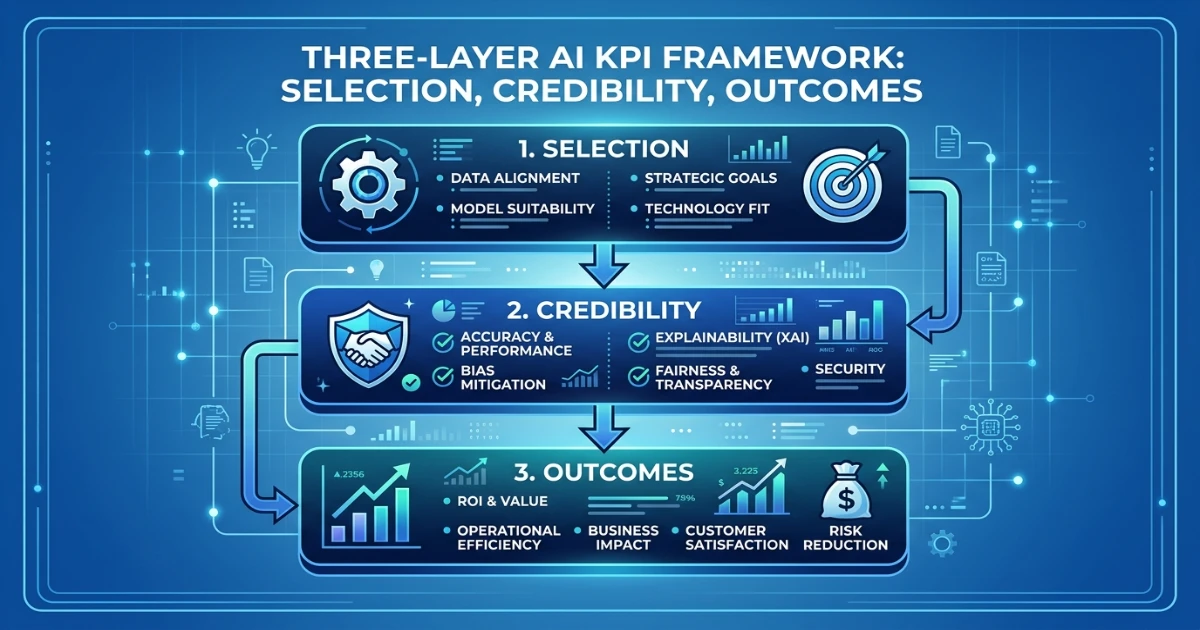
The most effective way to structure AI search reporting is through a tiered model that mirrors how AI selection actually works — from initial appearance to trustworthiness to commercial impact. Each tier builds on the previous one and answers a specific question for your stakeholders.
| Tier | Core Question | What It Measures |
|---|---|---|
| Tier 1: Selection | Are we being chosen? | AI Overview coverage, brand inclusion rate, competitive gap |
| Tier 2: Credibility | Why are we chosen or skipped? | Citation quality, authority consistency, entity clarity, sentiment |
| Tier 3: Outcomes | What business impact results? | LLM conversion rate, pipeline attribution, assisted demand signals |
Lead your reporting in this order. Start with selection — it establishes presence. Move to credibility — it explains the why. Close with outcomes — it justifies the investment. This narrative flow makes AI performance understandable to any stakeholder, regardless of their technical background.
Selection KPIs — Are We Being Chosen by AI?
Selection KPIs answer the most fundamental question in generative search: is your brand present when AI delivers answers on your target topics? Before you can optimise anything else, you need to know whether you’re in the conversation at all.
AI Overview Coverage by Query Cluster
Not all queries trigger AI Overviews. Your first task is to identify which keyword clusters in your niche generate AI-powered answers, then calculate what percentage of those clusters include your content. Use Google Search Console data alongside manual SERP sampling to identify triggers, then track your inclusion rate over time.
Brand Inclusion Rate
This metric measures how often your brand is cited when an AI Overview appears for a relevant query. Express it as a percentage: if AI Overviews appear for 100 of your target queries and your brand appears in 23 of them, your inclusion rate is 23%. Segment this by intent — informational, commercial, and transactional queries often show very different rates, and the gaps reveal where to focus.
Competitive Inclusion Gap
Run the same inclusion analysis for your top competitors. Where they appear and you don’t is your highest-priority content and authority gap. This gap analysis is one of the most actionable outputs of any SEO audit in the generative search era.
AI Visibility Score
A composite measure of how consistently your brand appears across AI Overviews, featured snippets, direct answers, and voice search responses. Track this across your full keyword universe and monitor it weekly. Sudden drops often signal content quality issues, entity confusion, or negative sentiment entering AI training signals.

Why AI Trusts Certain Brands Over Others
AI systems don’t select sources randomly. They prioritize brands that demonstrate consistent expertise, strong entity signals, and authoritative content structures. Understanding these trust factors is essential to improving your selection and credibility metrics. Our Answer Engine Optimization framework is built specifically around these signals.
- Clear brand identity and structured data — Organization schema, sameAs links, and consistent NAP reduce entity ambiguity
- Consistent mentions across trusted third-party sources — Unlinked brand mentions on authoritative domains increase AI citation frequency by up to 40%
- Topical authority and deep content clusters — Comprehensive pillar-and-cluster architecture signals domain expertise to AI models
- High-quality internal linking — Strong interlinking helps AI crawlers map your knowledge graph and understand content relationships
- Verified author credentials and E-E-A-T signals — Named authors with verifiable expertise dramatically improve credibility scoring
Credibility KPIs — Why Is AI Choosing Us or Skipping Us?
Selection tells you whether you’re in the answer. Credibility tells you why. These metrics examine the quality signals that AI systems use to evaluate trustworthiness — and the gaps that cause AI to select a competitor instead of you.
Citation Quality Mix
Which pages are actually being pulled into AI answers? Track this by content type: product pages, long-form guides, FAQ pages, how-to content, and third-party mentions. AI systems disproportionately cite structured, well-organized content that directly addresses specific questions. If your guides aren’t being cited but your competitors’ are, you have a content format problem.
Authority Consistency
Does AI repeatedly reference the same pages and assets from your site, or are citations scattered across thin and inconsistent content? Consistent citation patterns signal that AI has identified stable authority on a topic. Fragmented patterns suggest that your topical coverage is shallow or poorly interlinked — exactly the kind of issue that a structured technical SEO review can surface and fix.
Entity Clarity and Expertise Signals
AI language models use entity recognition to evaluate whether a source is credible. Clear author bios with credentials, consistent NAP data (for local brands), organization schema markup, sameAs links to authoritative directories, and structured data on key pages all reduce ambiguity. Brands with strong entity clarity are demonstrably more likely to be cited.
This is a core pillar of AI-era SEO: making sure that machines can unambiguously identify who you are, what you do, and why you’re authoritative.
Sentiment Analysis
AI systems don’t just mention brands — they describe them. Whether that description is positive, neutral, or negative has a direct effect on downstream conversion and trust. Track AI sentiment across platforms: 52% of Gen Z users report trusting generative AI for purchase decisions. If AI describes your brand with qualifiers like “reports of mixed reviews” or “some concerns about,” those phrases are suppressing conversion before a single visit.
Target at least 70% positive sentiment across AI platforms, and address recurring negative themes with factual, well-sourced content rather than ignoring them.
Outcome KPIs — What Business Impact Does AI Visibility Create?
This is where AI search performance connects to the metrics that boards and finance teams care about. If you can demonstrate that AI visibility drives qualified leads and revenue — even as click volumes decline — you shift the entire conversation from “SEO is losing traffic” to “AI is generating higher-quality demand.”
LLM Conversion Rate
Create custom channels in GA4 for AI referrers: chatgpt.com, perplexity.ai, claude.ai, gemini.google.com, and bing.com (for AI-assisted results). Compare conversion rates against traditional organic traffic. The data here is compelling: Microsoft Clarity research found AI-referred visitors convert at 1.66% versus 0.15% for traditional organic search — over 10× higher. Semrush’s data points to a 4.4× improvement across categories.
Even a small volume of AI-referred traffic, if it converts at 10× the rate, can represent a material revenue contribution. Your outcome reporting should make this visible.
Assisted Demand Signals
AI search influences behaviour without always creating a direct referral. Measure the secondary signals: branded search lift following periods of high AI visibility, growth in direct traffic, increases in demo requests or contact form completions that can’t be attributed to paid or email campaigns. These signals indicate that AI is building brand awareness in a way that shows up downstream.
Pipeline Outcomes: MQLs, SQLs, and Revenue Attribution
For B2B teams, track marketing-qualified leads and sales-qualified leads arriving from AI-referred sessions. Use CRM tagging to follow those leads through the funnel. Forrester data shows that AI-generated traffic now accounts for 2–6% of total organic traffic and is growing at 40%+ per month. At those growth rates, AI referral attribution will be commercially significant within one to two quarters for most businesses.

Five GEO Metrics Every Brand Should Track in 2026
Generative Engine Optimization (GEO) has its own metric layer that sits alongside and complements the three KPI tiers. These five metrics focus specifically on citation dynamics across AI platforms — and together, they give you a detailed picture of your AI authority.
Citation Frequency
How often your brand is explicitly referenced in AI responses across ChatGPT, Perplexity, Google AI Overviews, and Claude. Benchmark: 30%+ for your primary category queries is strong performance.
Brand Visibility Score (BVS)
Composite metric combining citation frequency, placement (headline vs. body vs. footnote), link presence, and sentiment. Automated by tools like Otterly.ai and Semrush AI Toolkit.
AI Share of Voice (AI SOV)
Your brand’s share of total AI citations in your category. Aim to exceed your market share by 10–20%. HubSpot now treats this as a primary performance metric.
Sentiment Analysis
Tracks whether AI platforms describe your brand positively, neutrally, or negatively across responses. Target 70%+ positive. Negative themes need proactive content remediation.
LLM Conversion Rate
Conversion rate of visitors arriving from AI platforms vs. traditional organic search. AI-referred traffic consistently converts at significantly higher rates — often 10× or more.
The Best Tools for Tracking AI Search Visibility in 2026
Purpose-built AI visibility platforms have matured significantly in the past 12 months. If you’re managing a meaningful SEO programme, manual tracking alone won’t scale — these tools automate the data collection, normalize it across platforms, and surface the competitive gaps that matter.
Unified AI visibility tracker covering Google AI Overviews, ChatGPT, Perplexity, and Gemini. Provides citation scores, brand mention monitoring, and competitor benchmarking in a single dashboard.
Calculates the Brand Visibility Index by combining citation frequency, placement, link presence, and sentiment. Strong for tracking BVS over time.
Integrates AI visibility data with existing SEO workflows. Offers a free AI visibility checker as an entry point for smaller teams.
Specialises in sentiment analysis and hallucination detection — ensuring AI-generated statements about your brand are factually accurate and positive.
Automates prompt testing across AI platforms and tracks brand mention changes. Particularly useful for competitive share of voice monitoring.
Track AI citations and share of voice across multiple AI models with daily updates. Strong for multi-brand or agency-level reporting.
How to Track AI Visibility Manually (Without Paid Tools)
If you’re not ready to invest in dedicated platforms, a structured manual audit can establish your baseline. This process is particularly useful for initial benchmark-setting before tool adoption.
- Build a prompt library. Create a spreadsheet with 20–50 queries covering category terms, comparison queries, problem-solution questions, and direct recommendation prompts (“What’s the best [product] for [use case]?”).
- Run weekly audits. Test each prompt across ChatGPT, Perplexity, Claude, and Google. Record: brand mentioned (yes/no), position in response (headline/body/footnote), link present (yes/no), competitors cited, sentiment (positive/neutral/negative).
- Calculate your metrics. Derive citation frequency and AI SOV from your audit spreadsheet. Track week-over-week trends to identify movement after content or authority changes.
- Set up GA4 custom channels. Create channel groupings for chatgpt.com, perplexity.ai, claude.ai, and other AI referrers. Separate these from traditional organic traffic and compare conversion rates.
- Augment with free tools. Semrush’s free AI visibility checker and Answer Socrates’ LLM Brand Tracker (free tier) can supplement manual audits without additional cost.
How to Integrate These KPIs Into Your Ongoing SEO and GEO Strategy
Metrics only create value when they drive decisions. Here’s how to connect your AI search KPI framework to concrete optimization work — and how to build a continuous improvement loop that compounds over time.
Audit and Cluster Your Content
Use your prompt audit results to identify topic areas where your brand is absent from AI citations. Build comprehensive pillar pages covering those topics, supported by tightly interlinked cluster content. Internal linking depth and topical coverage breadth are strong signals of subject-matter authority — exactly what AI models look for when choosing which sources to cite.
Optimize for AI Selection (AEO Best Practices)
Apply Answer Engine Optimization principles to your highest-value pages. Use question-based H2 and H3 headings that directly match how users phrase queries. Provide concise, direct answers in the first paragraph of each section. Add FAQPage, HowTo, and Article schema markup. Write in a conversational register that mirrors how users speak to AI assistants — because many AI queries are verbatim conversational prompts.
Strengthen Your E-E-A-T and Entity Signals
AI systems evaluate credibility using many of the same signals Google’s quality rater guidelines describe as E-E-A-T (Experience, Expertise, Authoritativeness, Trustworthiness). Add detailed author bios with verifiable credentials to content pages. Implement Organization and Person schema. Earn third-party mentions through digital PR and thought leadership — research shows brands with more unlinked mentions appear 40% more frequently in AI answers. Maintain consistent entity information across all platforms.
Optimize AI Landing Pages for Conversion
Create or refine landing pages specifically for high-intent AI-referred visitors. These visitors are already informed and pre-qualified by the AI answer — they need faster paths to conversion, not more information. Test cleaner layouts, stronger calls to action, and reduced friction on forms. Even modest conversion rate improvements on AI-referred traffic can produce significant revenue given the quality differential.
Shift Stakeholder Language
One of the most important things you can do with this framework is change the reporting conversation. Stop leading with “rankings dropped” or “sessions declined.” Start leading with “our AI inclusion rate grew from 12% to 29% this quarter, and AI-referred revenue is up 64%.” This framing reflects how search actually works in 2026 and positions your SEO investment as an AI visibility asset rather than a traffic channel under threat.
Frequently Asked Questions About AI Search KPIs
What are AI search KPIs and how are they different from traditional SEO metrics?
AI search KPIs measure brand presence, credibility, and commercial impact within AI-generated answers — rather than tracking keyword rankings and organic clicks. While traditional SEO metrics measure what happens after a user clicks a search result, AI search KPIs measure influence at the point where decisions are made: inside the AI response itself. Key metrics include citation frequency, brand inclusion rate, AI share of voice, and LLM conversion rate.
Why are traditional SEO metrics no longer enough in 2026?
Generative AI has fundamentally changed how search results are consumed. Up to 60% of Google queries now end without a click, and organic CTR for AI Overview queries has fallen from 1.41% to 0.64%. Meanwhile, 89% of B2B buyers use generative AI during their purchase process. If your reporting only measures visits and rankings, you’re missing the entire upstream influence phase where brand selection actually happens.
What is brand inclusion rate in AI search?
Brand inclusion rate is the percentage of AI-generated answers for your target queries that explicitly mention or cite your brand. A rate of 0–5% is common for brands that haven’t optimized for AI visibility. Reaching 25–35% for high-priority query clusters is a strong performance target. Low inclusion rates indicate content gaps, weak entity signals, or authority shortfalls relative to cited competitors.
What is AI Share of Voice (AI SOV) and how do you measure it?
AI Share of Voice measures what percentage of total AI citations in your category belong to your brand, compared to competitors. Measure it by running a consistent set of category-level prompts across AI platforms, recording all cited brands, and calculating your share of total mentions. Aim to exceed your market share by 10–20%. Tools like Wellows, Rankscale, and Promptmonitor automate this measurement across platforms.
What is the LLM conversion rate and why does it matter?
LLM conversion rate is the percentage of website visitors arriving from AI platforms (ChatGPT, Perplexity, Claude, Gemini) who complete a desired action — lead form, purchase, demo request. Research consistently shows AI-referred visitors convert at dramatically higher rates: 1.66% versus 0.15% for traditional organic visitors in Microsoft Clarity data. This makes AI referral traffic commercially disproportionate to its volume, and tracking it separately in GA4 is essential.
How do you track AI search visibility without expensive tools?
Build a library of 20–50 target prompts and run weekly manual audits across ChatGPT, Perplexity, Claude, and Google. Record brand mentions, placement, competitor citations, and sentiment in a spreadsheet. Calculate citation frequency and AI SOV from your data. Supplement with Semrush’s free AI visibility checker. Create custom GA4 channel groupings for AI referrers to track conversion performance without paid tools.
What is Generative Engine Optimization (GEO)?
Generative Engine Optimization is the practice of optimizing content, entity signals, and authority markers so that AI search engines select, cite, and recommend your brand. GEO expands on traditional SEO and AEO by focusing on AI-specific factors: structured content formats, entity clarity, citation-worthy expertise, and consistent third-party mentions. It’s now a core component of any comprehensive search visibility strategy.
Which content formats are most likely to be cited by AI search engines?
AI systems disproportionately cite structured, well-organized content that directly addresses specific questions. The highest-performing formats include comprehensive how-to guides with clear numbered steps, FAQ pages with concise answers, original research with citable statistics, and authoritative comparison pages. Schema markup — particularly FAQPage, HowTo, and Article schema — increases the likelihood of AI citation and featured snippet selection.
How does AI search visibility influence B2B purchase decisions?
Forrester research shows 89% of B2B buyers use generative AI during their purchase journey. AI answers shape the shortlist before a buyer visits any vendor’s website. Brands cited positively in AI responses benefit from pre-qualified intent — the buyer arrives already informed and already favorably disposed. This is why AI-referred B2B traffic tends to have shorter sales cycles and higher close rates than cold organic traffic.
What is the Brand Visibility Score (BVS) and how is it calculated?
The Brand Visibility Score is a composite AI search metric that combines four factors: citation frequency (how often you’re mentioned), placement (whether your brand appears in the headline vs. body vs. footnote of an AI response), link presence (whether a clickable link accompanies the mention), and sentiment (positive, neutral, or negative). Tools like Otterly.ai and Semrush’s AI Visibility Toolkit calculate this score automatically and provide trend tracking.
The Shift Has Already Happened — Now You Need to Measure It
AI search isn’t a future consideration. It’s the current reality. Zero-click rates are accelerating. Generative answers are expanding into more query types every month. And the brands that are building citation authority right now will have a structural advantage as AI search becomes the dominant discovery channel.
The three-tier KPI framework — Selection, Credibility, Outcomes — gives you the structure to report on AI visibility in a way that makes strategic sense. The five GEO metrics give you the granularity to identify exactly where to focus. And the tools and manual processes covered here give you a practical path to start measuring immediately, regardless of budget.
The brands that win in AI search will be the ones that measure correctly, optimize deliberately, and report in a language that reflects how search actually works in 2026. Rankings and sessions are not that language anymore.
AI Search KPI Framework Summary
The AI search performance model in 2026 is built on three layers: visibility (selection), trust (credibility), and revenue (outcomes). Brands that optimize across all three consistently outperform competitors in AI-generated results — earning more citations, stronger sentiment, and higher-converting referral traffic. The framework is not theoretical: it maps directly to how generative engines evaluate, rank, and recommend sources when composing answers. Implement it through structured AI SEO services or through the manual audit process outlined above.
Ready to Measure Your AI Search Visibility?
Our team specialises in AI SEO, GEO strategy, and performance measurement frameworks built for generative search. Let’s audit your current visibility and build a tracking system that tells the real story.
Get Your AI Visibility Audit →Enjoying our SEO & AI search insights?
Make AliSEOservices.com a Preferred Source on Google to see our SEO, AEO, local search and AI visibility insights more prominently in your Google experience.