Introduction: A Question Many Businesses Are Asking
If you search your primary keywords today, you may notice something different at the top of Google.
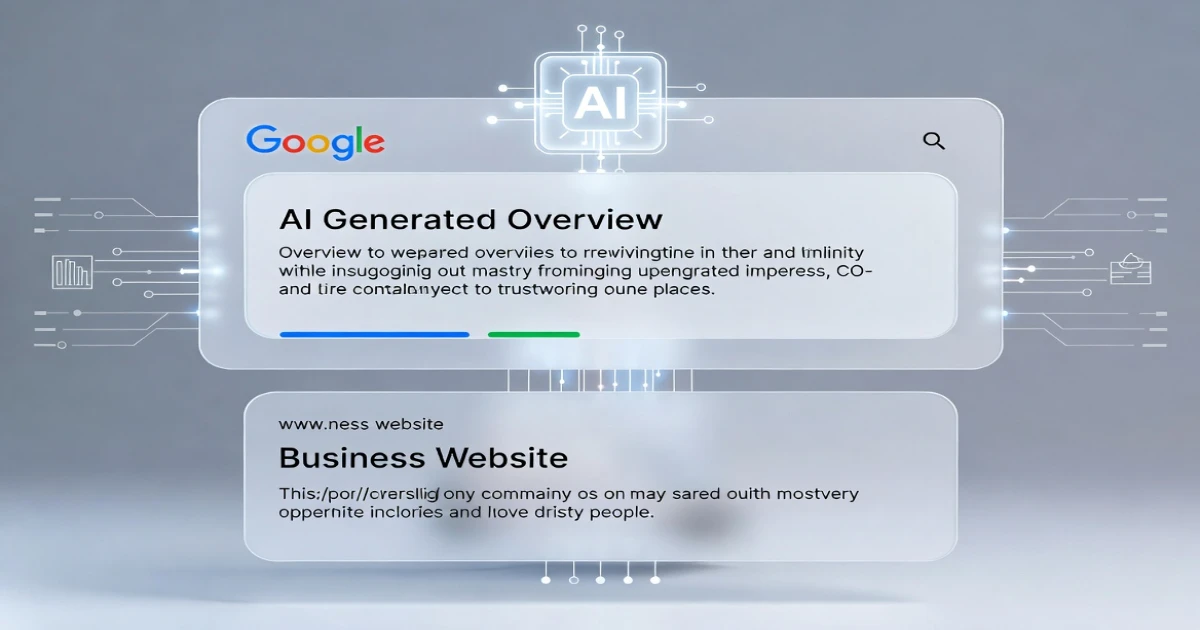
Instead of the usual list of websites, Google now often shows an AI Overview — a summary that answers the question before traditional results appear.
For many business owners, this immediately raises a reasonable concern:
“My website ranks well — so why isn’t it appearing in Google AI Overviews?”
It’s a valid question.
And the answer is not as mysterious or technical as it’s often made out to be.
This guide explains why businesses may not appear in AI Overviews, what Google has officially clarified about them, and how to think about visibility in an AI-first search landscape — without hype, shortcuts, or so-called “secret AI SEO formulas.”
An Important Clarification Before We Go Further
Google has been clear on one key point:
AI Overviews do not require special optimization techniques beyond strong SEO fundamentals.
In simple terms:
- There is no separate “AI SEO” ranking system
- There is no guaranteed way to force inclusion
- High-quality organic SEO remains the foundation
However, this is where confusion often starts.
Not all pages that rank well are equally useful to AI systems.
And that difference explains why many businesses feel visible in search — yet absent from AI summaries.

Where AI Overviews Can Actually Benefit Businesses
Although AI Overviews can reduce some traditional clicks, they can still create meaningful value when your content is included.
Based on Google’s guidance and real-world behavior, several benefits stand out:
More Intentional Traffic
Users who scroll past an AI Overview or click through to a cited source often want deeper, more specific information, not surface-level answers.
Increased Brand Visibility
Being referenced in an AI Overview reinforces authority and recognition, even when users don’t immediately click — similar to featured snippets or knowledge panels.
Long-Term Content Resilience
Clear, well-structured, genuinely helpful content tends to perform better across:
- Traditional organic search
- AI summaries
- Voice assistants
- Zero-click and assistive search experiences
In short:
AI Overviews don’t remove SEO value — they redistribute it.
How Google AI Overviews Select Sources (High-Level View)
AI Overviews are designed to:
- Answer specific user questions
- Pull from multiple credible sources
- Present clear, concise, and balanced explanations
As a result, inclusion is influenced by factors such as:
- Relevance to the exact query
- Clarity and directness of the answer
- Source credibility and consistency
- Content structure and readability
- Overall topic coverage across the web
Not rankings alone.

Reason #1: Your Page Ranks — But Doesn’t Clearly Answer a Question
Many pages are optimized around keywords, not questions.
AI systems tend to favor content that:
- Directly answers a question
- Can stand on its own without heavy context
- Is easy to summarize accurately
For example, a long service page may rank well — but if it never clearly explains why something happens or how something works, it may not be selected for an AI summary.
What typically helps:
- Clear H2 and H3 questions
- Short, focused explanations under each heading
- Reduced marketing language in favor of plain clarity
This improves both user understanding and AI usability.
Reason #2: AI Overviews Prefer Topic Coverage, Not Isolated Pages
AI systems evaluate understanding at the topic level, not just at the page level.
A website with:
- One standalone article about AI Overviews
will usually be seen as less authoritative than a site that also covers: - AI search behavior
- Content clarity
- Search intent
- Structured content
- User experience
This is simply an extension of topical authority, something Google has valued long before AI Overviews existed.
Reason #3: Source Trust and Brand Signals Matter More Than Ever
AI Overviews frequently reference:
- Established publishers
- Well-known platforms
- Sources with consistent identity and expertise
That’s why you often see:
- Wikipedia
- Major blogs
- Industry authorities
This does not mean smaller businesses are excluded.
It does mean trust signals matter:
- Who is behind the content?
- What experience do they demonstrate?
- Is the site consistent, credible, and transparent?
Reason #4: Structure Helps AI — Even If It’s Not a Ranking Requirement
Google does not state that schema or formatting is mandatory for AI Overviews.
In practice, however:
- Clean structure
- Logical headings
- FAQ sections
- Clear explanations
make it easier for AI systems to extract and present information accurately.
This is the same reason structured writing helps with:
- Featured snippets
- Voice search
- Accessibility
- Human comprehension
Think of this as clarity optimization, not AI manipulation.
Reason #5: AI Overviews Intentionally Mix Sources
AI Overviews are designed to present diverse perspectives.
Even if your content is strong, Google may also include:
- Forums
- User-generated content
- Research or news sources
So being excluded does not automatically mean your SEO is weak.
Sometimes it simply means:
- Google wanted a broader mix of viewpoints
- Your content overlapped with sources already selected
Reason #6: Not All Queries Trigger AI Overviews Reliably
AI Overviews appear more often for:
- Informational queries
- Exploratory questions
They appear less consistently for:
- Service-based queries
- Location-specific searches
- Purchase-driven intent
If your main keywords are transactional or local, limited AI Overview visibility is normal, not a failure.
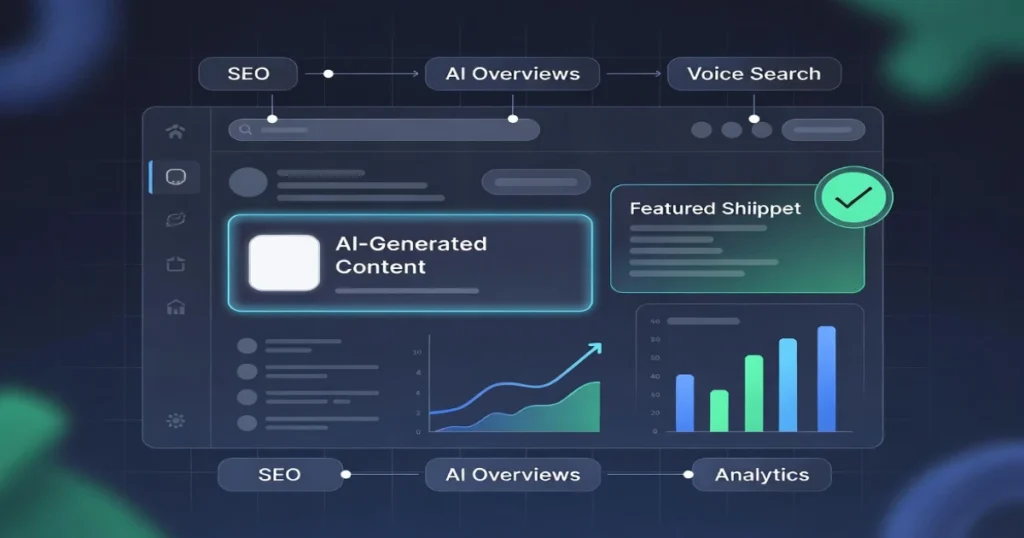
The Real Goal: Being AI-Compatible, Not AI-Focused
Rather than trying to “optimize for AI Overviews,” the practical goal is simpler:
Create content that is easy to understand, easy to trust, and genuinely useful.
When you do that:
- SEO improves
- User experience improves
- AI citation likelihood increases
- Your content becomes future-proof
Real Query Examples (Simple and Practical)
Informational query (high AI Overview likelihood):
“Why is my website not showing in Google AI Overviews?”
AI goal: Explain causes and context
Typical sources: Guides, expert blogs, explanations
Transactional query (low AI Overview likelihood):
“SEO agency in Dubai”
AI goal: Minimal or none
Likely outcome: Local pack and organic listings
This explains why many service businesses don’t see AI Overviews for their core revenue keywords — and why that’s expected.
How to Monitor AI Overview Impact (Without Guesswork)
Google doesn’t yet offer a dedicated AI Overview report, but you can still track impact using existing tools.
In Google Search Console:
- Monitor impression trends, especially for informational queries
- Watch for rising impressions with stable or lower clicks
- Compare branded vs non-branded query growth
What matters most:
- Are impressions increasing?
- Is brand visibility improving?
- Are conversions happening later in the journey?
AI visibility often shows up before direct conversion signals.
A Simple Self-Check (No Tools Needed)
Ask yourself:
- Does this page clearly answer a real question?
- Can someone understand it in under 30 seconds?
- Is the expertise behind it obvious?
- Is it genuinely better than what already exists?
If the answer is mostly yes, you’re already moving in the right direction.
Final Thoughts: Calm Beats Hype in the AI Era
AI Overviews haven’t replaced SEO.
They’ve simply:
- Raised the bar for clarity
- Rewarded genuine expertise
- Reduced the value of thin or vague content
Businesses that prioritize helpfulness over hacks are the ones best positioned to succeed — both in AI-driven search and traditional results.
Want to See How Your Site Performs in AI Search?
If you’re curious how clearly Google understands your content — and whether your pages are well-positioned for AI-driven search experiences — a structured review can help surface blind spots.
This isn’t about “optimizing for AI tricks.” It’s about improving clarity, trust, and usefulness — the same qualities that drive long-term SEO success.
FAQs
1. What are Google AI Overviews?
Google AI Overviews are AI-generated summaries that appear at the top of search results. They combine information from multiple trusted sources to quickly answer a user’s question before showing traditional listings.
2. Why is my website not showing in Google AI Overviews?
Most websites don’t appear because their content doesn’t clearly answer specific questions, lacks strong topic coverage, or doesn’t provide enough clarity for AI systems to summarize accurately.
3. Do I need special SEO to appear in AI Overviews?
No. Google has stated that AI Overviews rely on strong SEO fundamentals such as high-quality content, clear structure, relevance, and trust — not special or separate “AI SEO” techniques.
4. Does ranking number one guarantee inclusion in AI Overviews?
No. Ranking well helps, but inclusion also depends on how clearly a page answers the question, how trustworthy the source is, and whether Google wants multiple perspectives.
5. What type of content appears most often in AI Overviews?
Informational and explanatory content appears most often, especially pages that answer “why,” “how,” and “what” questions in a clear and structured way.
6. Why do forums like Reddit appear in AI Overviews?
Google includes forums to show real-world experiences and diverse viewpoints. AI Overviews are designed to balance expert explanations with user perspectives.
7. Can local or service-based businesses appear in AI Overviews?
Yes, but less consistently. AI Overviews appear more frequently for informational searches than for transactional or location-based queries.
8. Do AI Overviews reduce website traffic?
Sometimes they reduce immediate clicks, but they can also increase brand visibility and lead to higher-intent traffic later in the user journey.
9. How can I tell if AI Overviews are affecting my website?
You can monitor changes in impressions, branded searches, and assisted conversions using Google Search Console, even though there’s no dedicated AI Overview report yet.
10. Is structured content important for AI Overviews?
Yes. While not mandatory, clear headings, concise answers, and logical structure make it easier for AI systems to understand and summarize your content accurately.
11. Are AI Overviews replacing traditional SEO?
No. AI Overviews are an extension of search, not a replacement. Strong SEO fundamentals still determine visibility across both AI and traditional results.
12. What is the best long-term strategy for AI search visibility?
The most effective strategy is creating content that is genuinely helpful, easy to understand, and clearly demonstrates expertise — regardless of whether it’s read by humans or summarized by AI.
Enjoying our SEO & AI search insights?
Make AliSEOservices.com a Preferred Source on Google to see our SEO, AEO, local search and AI visibility insights more prominently in your Google experience.