SEO for Professional Firms · Dubai
SEO for Accounting Firms in Dubai: Search That Signs Engagements
Business owners in Dubai don’t search for “an accounting firm”. They search for the exact financial problem sitting on their desk — books months behind, an audit a bank is asking for, a tax question they can’t afford to get wrong. The firms that win those searches structure their websites around the way owners actually look: one page per service line, one signal per district, and trust evidence exactly where a cautious buyer checks it.
How accounting search actually works in Dubai
Owners search the service, not the firm: bookkeeping, audit, VAT, corporate tax, payroll, CFO — each its own query cluster.
Winning firms give each service line its own page, build district-level signals for Dubai’s business hubs, keep reviews and credentials visible where cautious owners check trust, and publish compliance-season content before the search surge — not during it.
Accounting buyers are high-value and read-heavy. Depth wins here, not volume.
Search behaviour
How companies in Dubai actually search for an accounting firm
There are four search patterns that produce almost every signed engagement. They look nothing like a brand search — and they reward completely different site structures.
1. Service-line searches
Prospects search the job to be done, not the firm. A founder with a VAT question types VAT consultant in Dubai; a bank asks a borrower for an audited statement and the borrower types audit firm in Dubai. Observed query themes include bookkeeping services in Dubai for small businesses, VAT filing services Dubai, external audit services Dubai, payroll services in Dubai, FTA-approved tax agents Dubai and management accounting services Dubai. Each theme is a page-sized opportunity — and each one a firm misses entirely if it publishes only a generic services page.
2. District-led local intent
Dubai’s business hubs behave like micro-markets: auditing firm in Business Bay, tax consultants in DIFC, bookkeeping services JLT. Map-pack presence and “near me” behaviour matter here, but agencies working this niche note that a bare accountant near me query is low-value on its own — the money sits in service-plus-district combinations, where intent is specific enough to pick a shortlist from.
3. Compliance-event spikes
Search concentrates around regulatory moments — filing seasons, new reporting requirements, e-invoicing themes. Firms that publish plain-language explainers before the surge capture the wave; firms that react during it compete against everyone who planned ahead. This is a calendar play as much as a content play: the winners treat each compliance event as a campaign with a publish date.
4. Trust-verification searches
Because the buyer hands over their books, the shortlist gets checked. Review pages, credential pages, “is X firm legit” style queries and Google Business Profile panels are all part of the search journey. A firm can rank the service page and still lose the engagement if what a cautious owner finds next looks thin.
The pattern that decides everything: high value per client, and searchers who read a lot before calling. A Dubai accounting engagement is worth enough that no owner signs from a headline — they read the page, check the reviews, glance at the profile, then book. That is why depth wins here and thin pages don’t: the page has to survive a careful reader, not just a crawler.
Page architecture
The service-line pages that win audit, bookkeeping and tax searches
One page cannot rank for bookkeeping, audit and tax at once — the queries, the intent and the proof points are all different. The winning structure gives every service line its own page, written for the buyer of that service alone.
| Service line | What the page must prove | Search themes it owns |
|---|---|---|
| Bookkeeping | Ongoing reliability: clean books, monthly rhythm, software fluency, SME focus. | bookkeeping services in Dubai, small-business bookkeeping, catch-up bookkeeping |
| Audit & assurance | Independence and rigour: what an audit covers, how the process runs, who the reports satisfy. | audit firm in Dubai, external audit services, IFRS-compliant audit UAE |
| VAT consultancy | Practical handling of registration, filing and record-keeping themes — method, not advice. | VAT consultant in Dubai, VAT filing services, VAT registration support |
| Corporate tax | Clarity on process and timelines as a search theme; the rules themselves belong in consultation. | corporate tax consultant Dubai, corporate tax return filing support |
| Payroll | Accuracy and confidentiality: WPS-linked processing, payslips, end-of-service handling. | payroll services Dubai, outsourced payroll UAE |
| CFO & advisory | Strategic depth: reporting, budgeting, investor-ready numbers for growing firms. | outsourced CFO Dubai, management accounting services, financial reporting |

The rule of thumb: if two services would answer the same search query with the same content, they can share a page. Bookkeeping and audit never would — the buyer, the urgency and the evidence are different in every line. That separation is also what stops the firm’s own pages from competing against each other in search.
Local SEO
Dubai’s districts are micro-markets
A consultancy in DIFC and a startup in JLT search differently even for the same service — and both expect the firm to feel local. District pages and a living Google Business Profile turn geography into pipeline.
Service + district pages
Build location pages only where the firm can genuinely serve: each page names the district, the service lines relevant to the businesses there, and a real point of contact or meeting option. A page that swaps one suburb name for another across fifty clones reads as exactly what it is — write fewer, and make each one honest about the local fit.
A profile that works between searches
The Google Business Profile is the firm’s second homepage for local queries: accurate categories, service lines listed, review replies that mention the service delivered, and regular posts — one agency working the niche recommends weekly “tax alert” style updates as a visibility tactic. Citations on UAE business directories then confirm the same name, address and phone everywhere a checker looks.
Trust signals
Reviews and credentials decide the shortlist
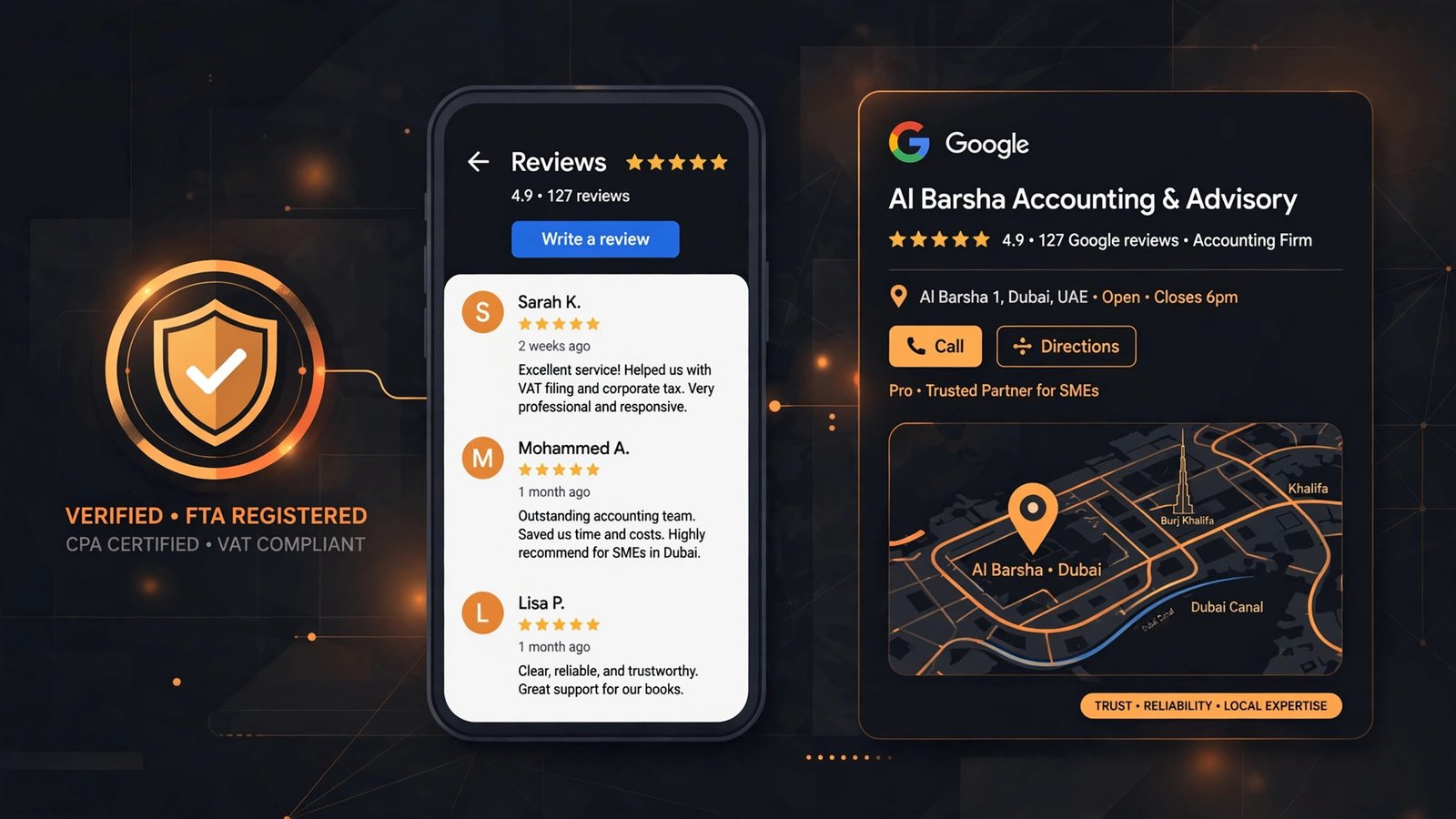
Ranking the service page gets the firm into the consideration set. What happens next — a review page, a profile panel, a credential check — decides whether the owner books or bounces.
- Reviews that mention the service. A five-star review that says “handled our VAT filing cleanly and answered every question” sells the next VAT searcher. Firms should ask clients to describe the job done, not just the star rating — and reply to every review with the same specificity, which keeps the profile looking managed.
- Credentials stated plainly. Registrations, tax-agency status and professional memberships belong on the site and the profile exactly as they are held — named, dated, verifiable. Never claim a credential the firm doesn’t hold: in a trust-first category, one invented badge destroys the whole page’s credibility the moment an owner checks it.
- Evidence over adjectives. “Trusted by businesses across Dubai” convinces nobody. Process pages that show how an audit runs, what a monthly bookkeeping engagement includes, and how onboarding works convince the careful reader who is actually comparing.
- Consistency everywhere. The same firm name, phone, address and service list on the site, the GBP and UAE directories. Mismatches are read as risk signals by exactly the buyers this sector can least afford to spook.
Content strategy
Winning VAT and corporate-tax searches — without giving tax advice
Tax topics carry the highest search volume in this niche and the highest responsibility. The method: publish about the search themes, keep the actual guidance inside the consultation.
Explain the process, not the rules
Pages can walk through what a VAT or corporate-tax engagement looks like — what records a firm asks for, how a review meeting runs, what “filing season” means for workload — without stating a single rate, deadline or filing instruction as advice. The searcher gets oriented; the advice stays licensed.
Publish the calendar content early
Compliance-event explainers (“what changes this filing season” style content) should be live weeks before the surge, when competition for the query is still thin. Dated honestly, updated yearly, and always linking the reader to the firm’s consultation rather than leaving them to act on a marketing page.
Answer the question behind the question
Most tax searches are anxiety searches: am I compliant, am I late, what did I miss? Content that acknowledges that anxiety and routes it to a review call converts better than content that pretends the answer fits in a paragraph. The CTA on tax content is a consultation, not a newsletter signup.
Keep a hard line on facts
Regulatory specifics — rates, thresholds, deadlines — belong to official sources and licensed advisors. Marketing pages should never state them as settled fact; when a regulatory detail matters to the story, it is either sourced from the official portal or left out. Getting this wrong costs more than a ranking: it costs trust.
The positioning this creates: the firm becomes the visible, careful voice on tax themes — the one owners find while researching — while every page makes clear that personalised advice happens in the consultation. That is both an SEO strategy and a professional-safety one.
The Dubai difference
What makes accounting SEO in Dubai different from generic B2B SEO
Accounting here runs on forces most B2B niches never face. The strategy has to be built for them.
Compliance-driven demand
Demand follows regulation, not fashion. When the compliance calendar moves, search moves with it — which means content planning starts from the regulatory year, not the marketing calendar. Firms that map content to compliance events own the surge; firms that don’t rent it at everyone else’s prices.
A high-trust, high-value shortlist
Owners hand over their books. The shortlist is short, the diligence is real, and the decision-maker reads everything. Every page has to survive that reader — which is why thin, template content fails here faster than in almost any other niche.
District hubs, not one market
DIFC, Business Bay, JLT, Deira: different business mixes, different service mixes, different searches. A Dubai-wide page plus honest district signals beats both a single generic page and fifty cloned location pages.
Two audiences, two languages of research
SME owners and multinational finance teams research differently — and across the UAE, part of the SME audience researches in Arabic first. Where a firm’s real enquiries arrive in Arabic, Arabic service pages are revenue pages; where they don’t, English depth wins. The firm’s own inbox is the research.
AI search
How AI Overviews and ChatGPT change how accountants get discovered
A growing share of “which firm should I use” research now happens inside AI answers. Those answers quote pages that are built to be quoted.
Structure that AI can cite
AI answers lift short, self-contained definitions and direct answers: a one-paragraph explanation of what an audit covers, a clean list of what a bookkeeping engagement includes. Pages built with those blocks — like this page’s short-answer boxes — get quoted; pages buried in prose get skipped.
Entity clarity across the web
AI systems assemble the firm from every source: the site, the GBP, directories, reviews. The same name, services and credentials everywhere is what lets an answer describe the firm accurately. Inconsistency doesn’t just confuse Google — it gets the firm misdescribed in front of a buyer.
Measurement
How to tell whether the SEO is actually working
Traffic is a vanity number in this niche. The only metrics that matter end in a booked consultation.
- Tracked consultation bookings. Every service-line page carries a booking path, and every booking is attributed to the page and query that produced it. A page that ranks but never books is a page to rebuild.
- Calls by service line. Call tracking per page shows which services the market actually wants — and which pages are winning the queries that end in engagements.
- GBP actions. Calls, direction requests and profile views per district signal whether the local layer is pulling its weight.
- AI-answer presence. Whether the firm’s definitions and pages appear inside AI Overviews and assistant answers for its core service queries — the discovery channel that didn’t exist two years ago.
- Pipeline, not positions. Rankings are a leading indicator; signed engagements are the number. The dashboard a partner actually reads lists consultations booked, by service line, by source.
Related
Where accounting-firm SEO connects
Accounting search doesn’t live alone — it sits inside the wider professional-services market in Dubai. New companies choosing a setup route need an accountant within weeks, which is why our SEO for business setup companies page pairs naturally with this one; professional firms facing the same trust-first shortlist will find the parallel playbook in our law-firms SEO work. Start either engagement with a detailed SEO audit, and see the fixed monthly pricing before you commit.
Key takeaways
The short version
- Owners search the service, not the firm — every service line needs its own ranking page.
- Dubai’s districts are micro-markets — service-plus-district queries beat generic local pages.
- Compliance events are campaigns — publish before the surge, not during it.
- The shortlist is decided after the click — reviews, credentials and the GBP close the engagement.
- Tax content explains themes, never rules — advice stays in the consultation.
- Depth wins, volume doesn’t — high-value, read-heavy buyers reward the careful page.
FAQ
Accounting-firm SEO, answered
They search the specific job to be done: bookkeeping, audit, VAT, corporate tax, payroll — usually with Dubai or a district attached. Service-line queries and service-plus-district queries produce the shortlists; brand searches come later, after the firm is already known. That is why one page per service line is the foundation of the whole structure.
A substantive page for each service the firm actually sells — bookkeeping, audit and assurance, VAT consultancy, corporate tax, payroll, CFO and advisory — each written for that service’s buyer with its own proof points, process description and calls to action. District signals sit alongside the service pages where the firm can genuinely serve those areas, plus trust pages covering credentials, reviews and how engagements run.
They decide the shortlist after the click. Owners hand over their books, so they check reviews and the profile panel before calling — reviews that name the service delivered, replied-to reviews that show the firm is managed, and a complete profile with accurate categories and regular posts. In a trust-first niche, the profile is effectively a second homepage.
Content about the process and the search themes — what an engagement looks like, what records a review typically needs, how filing-season planning works — while rates, deadlines and filing instructions are never stated as advice. Compliance-event explainers published ahead of the surge capture the highest-volume queries, and every tax page routes the reader to a consultation where licensed advisors give the actual guidance.
In booked consultations, not traffic. Track consultation bookings attributed to page and query, calls by service line, Google Business Profile actions per district, and whether the firm’s pages appear inside AI answers for its core service queries. Rankings are a leading indicator; the dashboard that matters lists engagements signed, by service line, by source.
More “which firm” research now happens inside AI answers, which quote pages built to be quoted: short definitions, direct answers, clean Q&A structure. Firms also get described from their whole web footprint — site, profile, directories, reviews — so entity consistency decides whether the answer describes them accurately. Pages written for citation win a discovery channel that barely existed two years ago.
Three things: demand follows the compliance calendar rather than the marketing calendar, so content planning starts from regulatory events; buyers are high-value and read heavily before calling, so depth beats volume on every page; and Dubai’s districts function as micro-markets, so service-plus-district signals matter more than generic local pages. Our accounting-firm SEO runs on fixed retainers — Foundation AED 1,500/month, Growth AED 3,500/month, Authority AED 6,500/month — with a detailed audit from AED 1,499 and a free 15-minute visibility review to start.
Free AI Visibility Audit
See which buying searches your firm’s site is missing
We map your current pages against service-line, district and compliance-season intent, check your AI-answer presence, and show you the build order — bookkeeping to audit to tax. Drop your details and we will run the audit.
Your buyers are searching the service right now. Be the firm the page names.
Build one page per service line, signal every district you serve, make trust verifiable — and measure it all in signed engagements.
Last updated: 2026 · Reviewed by Liaquat Ali, SEO Specialist